Today in the sixth round of the Altibox Norway Tournament in Stavanger, Levon Aronian smashed Vladimir Kramnik. I recommend playing through the game once yourself. Just give it a casual run through if you don't have a lot of energy. And then watch Peter Svidler's recap of the game. I'll embed the video here, but the video is on YouTube if you want to watch it on your TV instead.
Svidler's recap is pretty much a master class. I'm particularly struck by the section from the 6:30 to 8:24. The analysis flows quickly in the more tactical phase of the game, and I'm not going to pretend I caught all of it, especially in my current brain-dead state. But I'm going to go back to this again a couple of times this week - it's just that good. It's just over 22 minutes long, and I can't recommend it strongly enough.
Monday, June 12, 2017

Orlando Sunshine Open - Club Memeber Results
The Central Florida Chess Club held their annual Orlando Sunshine Open & Scholastic Tournament this weekend. The tournament also featured side events by ChessStars.com. The event was held at the Rosen Plaza at 9700 International Drive. Personally it was the best location I've ever played at for a chess tournament, with the possible exception of the old Fells Point Chess Club in Baltimore, Maryland, which is right next to a bar.
The purpose of this post, though, is to congratulate Paul Leggett for his fine performance of 4.5 out of 5 points in the U2000 section, which was good for a two-way tie for first. William Bowman held him to a draw, but he mowed throw the rest of the competition, including a grueling 92 move marathon against me.
As for my performance, and that of Connor, perhaps the best way to sum up the results would be with a cartoon dog in a funny hat.

The purpose of this post, though, is to congratulate Paul Leggett for his fine performance of 4.5 out of 5 points in the U2000 section, which was good for a two-way tie for first. William Bowman held him to a draw, but he mowed throw the rest of the competition, including a grueling 92 move marathon against me.
As for my performance, and that of Connor, perhaps the best way to sum up the results would be with a cartoon dog in a funny hat.

Tuesday, June 6, 2017
"The last soldier."
The last soldier. pic.twitter.com/PL1Krq7Kp5— Mohamed Al-Medaihki (@almodiahki) June 6, 2017
Someone responding to this claims it's from Kotov's Play Like a Grandmaster, but that's not one of the three Kotov books I own, so I can't verify it. Anyway, it's quite clever!
Tuesday, May 23, 2017
Tournament Players PROTIP #9
I may have posted this one before, but it bears repeating:
NEVER RESIGN.
Never. No matter what. More importantly still, resolve to never resign. Recently I won a game against a master after having chucked two pawns in the opening, leaving my king stuck in the center with my queen-side mostly undeveloped. However, I kept plodding along, and eventually even won the game. Yes, it was a junky quick-chess game, but I have won similar games at Game in 120 against A-players and below.
There are several reasons to not consider resigning. The first is that you can't win by resigning. It's a stupid, obvious, even trite saying, but it's true. Make your opponent prove they can win. Often they will relax after achieving a winning, or even won game, and will start playing non-optimal moves. And in slower games, especially, they will become annoyed, which usually isn't conducive to optimal chess. You are within your rights to do so, and may as well exercise them.
The second reason is that if you don't resign, you won't make a mistake by resigning an equal or favorable position. A few months ago I drew against another master. At some point, though, he played an unexpected move, and I thought I was losing my queen. I very briefly considered resigning, and then remembered my own advice. Looking at it again, I realized I wasn't losing my queen at all. The game continued and after a tough struggle, I scored the half-point. Perhaps I had been helped by the knowledge that a few months before that game, a 1900 had resigned against me because he thought his queen was trapped, even though it wasn't. Oops. Perhaps he wouldn't have seen the saving sequence anyway, but he "took me at my word" when he shouldn't have.
And finally, if you decide before a game to not resign, it saves energy. Resigning is a decision, just like any other move, and it requires energy. If you begin to consider resigning, it becomes a drain on finite reserves of energy available for the game/tournament. Thus deciding to not resign beforehand can save you energy in the heat of battle, especially time pressure. Even contemplating resigning in time pressure is a shameful waste. This is especially true as you get older and have less energy to spare.
All that said, I do resign sometimes. But it has to be really bad, and my opponent has to clearly be strong enough and have enough time of their own that I can't imagine them stalemating me by accident. But generally, I play every game out to mate. And as I've said before, you should expect your opponents to do the same, so don't get aggravated when they do so. It's their right to play on, as it is yours.
Finally, here's an example from the club last Saturday of fighting on beyond all hope, and then getting rewarded for it.

White had been completely busted for some time, but played on, hoping for a miracle. White stated that he hoped for Black to march his king up the board and somehow walk into a knight fork, so the spite checks began. Instead, Black,with more than ten minutes left on the clock, played ...Ke6, and White instantly played Re7#. White's dance of joy was most undignified, but quite understandable.
NEVER RESIGN.
Never. No matter what. More importantly still, resolve to never resign. Recently I won a game against a master after having chucked two pawns in the opening, leaving my king stuck in the center with my queen-side mostly undeveloped. However, I kept plodding along, and eventually even won the game. Yes, it was a junky quick-chess game, but I have won similar games at Game in 120 against A-players and below.
There are several reasons to not consider resigning. The first is that you can't win by resigning. It's a stupid, obvious, even trite saying, but it's true. Make your opponent prove they can win. Often they will relax after achieving a winning, or even won game, and will start playing non-optimal moves. And in slower games, especially, they will become annoyed, which usually isn't conducive to optimal chess. You are within your rights to do so, and may as well exercise them.
The second reason is that if you don't resign, you won't make a mistake by resigning an equal or favorable position. A few months ago I drew against another master. At some point, though, he played an unexpected move, and I thought I was losing my queen. I very briefly considered resigning, and then remembered my own advice. Looking at it again, I realized I wasn't losing my queen at all. The game continued and after a tough struggle, I scored the half-point. Perhaps I had been helped by the knowledge that a few months before that game, a 1900 had resigned against me because he thought his queen was trapped, even though it wasn't. Oops. Perhaps he wouldn't have seen the saving sequence anyway, but he "took me at my word" when he shouldn't have.
And finally, if you decide before a game to not resign, it saves energy. Resigning is a decision, just like any other move, and it requires energy. If you begin to consider resigning, it becomes a drain on finite reserves of energy available for the game/tournament. Thus deciding to not resign beforehand can save you energy in the heat of battle, especially time pressure. Even contemplating resigning in time pressure is a shameful waste. This is especially true as you get older and have less energy to spare.
All that said, I do resign sometimes. But it has to be really bad, and my opponent has to clearly be strong enough and have enough time of their own that I can't imagine them stalemating me by accident. But generally, I play every game out to mate. And as I've said before, you should expect your opponents to do the same, so don't get aggravated when they do so. It's their right to play on, as it is yours.
Finally, here's an example from the club last Saturday of fighting on beyond all hope, and then getting rewarded for it.

Black to move
White had been completely busted for some time, but played on, hoping for a miracle. White stated that he hoped for Black to march his king up the board and somehow walk into a knight fork, so the spite checks began. Instead, Black,with more than ten minutes left on the clock, played ...Ke6, and White instantly played Re7#. White's dance of joy was most undignified, but quite understandable.
Monday, May 8, 2017
King & Pawn Endgames: Answer Time
The other day I presented this position and asked a couple of questions.

But the winning line isn't 100% straightforward, either. Black still has to worry himself about that pesky g-pawn. How can he catch it and not let White clean up all of Black's pawns? The answer is that he can't. But that he doesn't have to, because White can be deflected from his own queenside pawns by the Black e-pawn, and that plus the unfortunate (for White) geometry between c4, e2 and g8, gives Black a winning position.
After 43...Kxd4 White's best is 44 Kd1 (If 44 g4, then Ke4, and Black will be able to round up the g-pawn and return in time to guard the e-pawn, and if Black tries breaking through on the queenside, Black's e-pawn queens far too quickly for White to get his pawns up the board):


And there's an unfortunate triangle for White. Another interesting fact is that all but one of Black's moves from 43 to 50 are only moves - anything other than the move given above loses. The one exception is that Black can play 44...c3 and still draw. These endings are precise!
...
On a programming note, I hope to return to semi-regular blogging, at the very least. Soon we will have final news on the on-going Club Championship, and there may even be a game or two worth noting.
St. Amant - Staunton, Paris 1843 (m11)

After 43 Kc3-c2
What is the proper assessment of the position? How many acceptable plans does Black have?The answers are that Black has a won position, and he has exactly ONE winning move. In fact, all moves other than 43...Kxd4 lose. Staunton chose to play 43...Ke4 and duly lost. I can only assume he originally intended to follow-up with 44... Kf3 and then promote his e-pawn. However, that plan does not work because of St. Amant's move, 44 Kd1, and now the White king will blockade the Black e-pawn, whilst Black has to run down White's d- and g- pawns, allowing White to easily win Black's queenside pawns. I don't know anything about the particulars of this game other than that Staunton was leading the match by the score of 8+, 1-, 1= prior to this game. Perhaps Mr. Staunton merely had a lapse.
But the winning line isn't 100% straightforward, either. Black still has to worry himself about that pesky g-pawn. How can he catch it and not let White clean up all of Black's pawns? The answer is that he can't. But that he doesn't have to, because White can be deflected from his own queenside pawns by the Black e-pawn, and that plus the unfortunate (for White) geometry between c4, e2 and g8, gives Black a winning position.
After 43...Kxd4 White's best is 44 Kd1 (If 44 g4, then Ke4, and Black will be able to round up the g-pawn and return in time to guard the e-pawn, and if Black tries breaking through on the queenside, Black's e-pawn queens far too quickly for White to get his pawns up the board):

After 44 Kd1
44 ... Kd3
45 g4 e2+
46 Ke1 Kc2!

After 46 ... Kc2!
47 g5
(47 Kxe2 transposes to the main line)
47 ... Kxb2
48 g6 c3
49 g7 c2
50 g8(Q) c1(Q)+
51 Kxe2 Qc4+
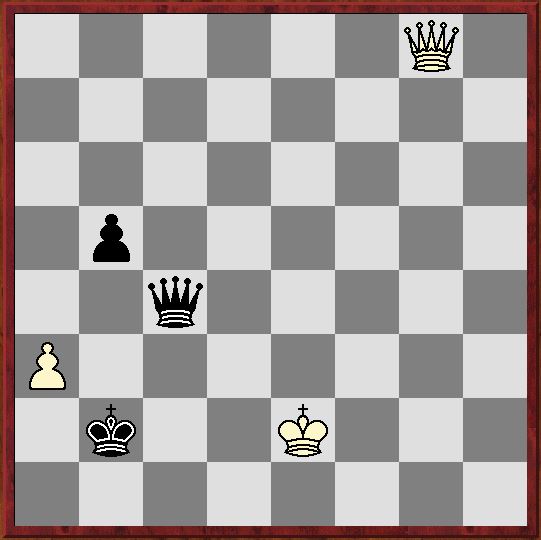
After 51 Qc4+
And there's an unfortunate triangle for White. Another interesting fact is that all but one of Black's moves from 43 to 50 are only moves - anything other than the move given above loses. The one exception is that Black can play 44...c3 and still draw. These endings are precise!
...
On a programming note, I hope to return to semi-regular blogging, at the very least. Soon we will have final news on the on-going Club Championship, and there may even be a game or two worth noting.
Making a living from chess?
Forbes has a new article about the prospects of making a living from chess. Tl;dr* version is that things are better than they used to be, but it's still tough. The article is interesting enough, but also familiar enough to chess veterans.
However, the article also has an interesting comment from Susan Polgar, which I give in full:
Still, I thought I would put this up for anyone that missed it. There's also a video at the site, with several of the people who were interviewed for the article commenting. So if you haven't seen enough Ben Finegold lately, here's your chance!
* tl;dr is internet parlance from those crazy kids for "too long; didn't read".
However, the article also has an interesting comment from Susan Polgar, which I give in full:
I completely disagree with the notion that making a good living in chess is hard. It is not.Of course, I'd like more data from the Forbes article, and I'd also like more information on who is making a living from chess from GM Polgar, although I can understand if she wouldn't want to name names.
Making a living from tournament winnings is hard. But making a living in chess in general is not. I have seen many amateurs, with ratings well below 2000, earn much more money than some top 10-20 players in the world.
The problem is professional players know chess. But they lack knowledge in business, management, marketing, and most importantly, people’s skill as well as communication skill. Some are just lazy to learn new skills to enhance their earning ability in chess.
There are plenty of people making a very good living in chess in California (both northern and southern Cal), New York, New Jersey, Illinois, Texas, Arizona, Oregon, Washington State, Maryland, Missouri, and many more states.
Still, I thought I would put this up for anyone that missed it. There's also a video at the site, with several of the people who were interviewed for the article commenting. So if you haven't seen enough Ben Finegold lately, here's your chance!
* tl;dr is internet parlance from those crazy kids for "too long; didn't read".
Wednesday, May 3, 2017
King & Pawn Endgames
Below is a position from the eleventh game of the 1843 match between Pierre Charles Fournier de Saint-Amant and Howard Staunton.
What is the proper assessment of the position? How many acceptable plans does Black have?
I'm not going to give the answers just yet. This is largely because I don't quite feel like typing it all up, but if I don't post something, I'm not going to get back to writing! But this is also a chance for the reader to work out the problem for himself - practice makes perfect, after all. So, have at it, reader, and enjoy!
St. Amant - Staunton, Paris 1843 (m11)
After 43 Kc3-c2
What is the proper assessment of the position? How many acceptable plans does Black have?
I'm not going to give the answers just yet. This is largely because I don't quite feel like typing it all up, but if I don't post something, I'm not going to get back to writing! But this is also a chance for the reader to work out the problem for himself - practice makes perfect, after all. So, have at it, reader, and enjoy!
Friday, February 24, 2017
King Bishop & Knight versus King
This ending came up again today, in the Women's World Championship. Harika almost blew this ending against Tan in the Semi-finals. Fortunately, she won it with four moves to spare.
Recently, this endgame had come up both online on Twitter and at the club, and the ending ALMOST came up during USATS last week for one of our players.
Personally, I know this ending, and think most players over 1600 can learn it easily. I practice it the week before tournaments until I can bang out the moves instantly. I use the old 'W' method, and find that sufficient. You can find that one in any endgame manual, but perhaps I'll try to find a good YouTube video later. However, in a discussion on Twitter, one @FoptimusSublime suggested the Three Triangles method as being easier. Here's the link to the YouTube video he provided:
https://www.youtube.com/watch?v=PWZ7h2yrJME
Having watched it, I don't find the method any easier than the traditional method, but it's really a matter of taste. Use whichever method you find easiest to understand, BUT LEARN THIS ENDING! It's not really that hard, and it could keep you from blowing a hard won half-point.
Recently, this endgame had come up both online on Twitter and at the club, and the ending ALMOST came up during USATS last week for one of our players.
Personally, I know this ending, and think most players over 1600 can learn it easily. I practice it the week before tournaments until I can bang out the moves instantly. I use the old 'W' method, and find that sufficient. You can find that one in any endgame manual, but perhaps I'll try to find a good YouTube video later. However, in a discussion on Twitter, one @FoptimusSublime suggested the Three Triangles method as being easier. Here's the link to the YouTube video he provided:
https://www.youtube.com/watch?v=PWZ7h2yrJME
Having watched it, I don't find the method any easier than the traditional method, but it's really a matter of taste. Use whichever method you find easiest to understand, BUT LEARN THIS ENDING! It's not really that hard, and it could keep you from blowing a hard won half-point.
Monday, February 20, 2017
Averbakh's Barrier or When an Extra Bishop Ain't What it Used to Be
Grandmaster Karsten Mueller of Germany is one of the world's premier endgame experts. In addition to writing several outstanding tomes on the endgame, he also regularly hosts chess endgame videos on Chessbase.com.
One of his recent videos covers the concept he calls Averbakh's Barrier. I have included a pair of small chessbase game examples to quickly demonstrate the concept.
Click here to see the concept in pure form
This idea has clear practical application, especially for players such as yours truly, who often find themselves a piece down and in desperate need of yet another swindle!
Of Course, one has to be on the lookout for such possibilities, which is where quality endgame study (coupled with an open mind and a devious nature) can come in handy.
The alternative is to simply lose, which is where GM Mueller comes in, offering an example of a loss that did not need to be:
Click here to learn from someone else's mistake!
One of the advantages of studying endgames is that such ideas and concepts have application beyond the specific situation- these methods lead to a better understanding of the relationship among the pieces, king, and pawns, thus enhancing our overall understanding of the game.
For those who would like to play through GM Mueller's original video to see what you have been missing, click below (and speak well of our friends at Chessbase for making such things available for free!)
GM Mueller's original Chessbase video on the concept!
One of his recent videos covers the concept he calls Averbakh's Barrier. I have included a pair of small chessbase game examples to quickly demonstrate the concept.
Click here to see the concept in pure form
This idea has clear practical application, especially for players such as yours truly, who often find themselves a piece down and in desperate need of yet another swindle!
Of Course, one has to be on the lookout for such possibilities, which is where quality endgame study (coupled with an open mind and a devious nature) can come in handy.
The alternative is to simply lose, which is where GM Mueller comes in, offering an example of a loss that did not need to be:
Click here to learn from someone else's mistake!
One of the advantages of studying endgames is that such ideas and concepts have application beyond the specific situation- these methods lead to a better understanding of the relationship among the pieces, king, and pawns, thus enhancing our overall understanding of the game.
For those who would like to play through GM Mueller's original video to see what you have been missing, click below (and speak well of our friends at Chessbase for making such things available for free!)
GM Mueller's original Chessbase video on the concept!
Tuesday, January 10, 2017
No Country for Old Men
GO players have been sent reeling in the last year. First came the AlphaGo program publicly beating one of the best GO players in the world early in the year. At the end of the year, that same program, temporarily disguised, tore through the rest of the GO community, winning 60 of 61 games online against all comers, including the best in the world. (The other game was drawn because of an internet connection failure.) Quote:
Certainty is a shaky foundation upon which to build the edifice of one's self.
HT: Alice Maz, whose tweet alerted me to this.
“Master” also claimed victories against a number of top Go pros including South Korea’s Park Jung-hwan and Japan’s Iyama Yuta, as well as beating China’s Ke Jie, who is currently ranked world number one, twice.GO had resisted the efforts of programmers for a very long time, unlike Chess, in which the programmers saw incremental improvement until they had surpassed human players. So we've had a long time to get used to this. But GO players are in shock, as AlphaGo seemed to come from nowhere to not only equal them, but surpass them by such a margin as to play at what appears to be a God-like level.
“When facing it, all traditional tactics are wrong,” commented Ke Jie after his defeat. Ke Jie had stated in December that he is currently not good enough to defeat AlphaGo.
However, [GO master] Gu [Li] struck a different tone on Weibo (a Chinese microblogging site like Twitter), saying, “AlphaGo has completely subverted the control and judgment of us GO players. I can’t help but ask, one day many years later, when you find your previous awareness, cognition and choices are all wrong, will you keep going along the wrong path or reject yourself?” This uncertainty was echoed by GO master Ke Jie [ranked #1 in GO], who said, “After humanity spent thousands of years improving our tactics, computers tell us that humans are completely wrong. I would go as far as to say not a single human has touched the edge of the truth of GO.” [emphasis added = ed.]Chess players haven't quite had the same reaction to being surpassed, but then Steinitz only started pulling back the curtain from the deeper truths of the game less than 150 years ago. That and our ever constant search for novelties and cooks probably saved us from such a deep crisis of faith.
Certainty is a shaky foundation upon which to build the edifice of one's self.
HT: Alice Maz, whose tweet alerted me to this.
Tuesday, January 3, 2017
A new rating system
The Grand Chess Tour has instituted a new rating system, which they call the Universal Rating System (tm). This rating combines all ratings (standard, rapid, blitz) into one rating. Their website explains the idea behind what they're doing and provides some evidence to show that their rating system is more accurate than the current Elo system in use by FIDE.
The people that actually did the work are Mr. Maxime Rischard, Dr. J. Isaac Miller, Dr. Mark Glickman, and Jeff Sonas. I don't recognize Rischard or Miller offhand, but Jeff Sonas and Mark Glickman are familiar names. Sonas did interesting work in the past on establishing good historical ratings, and Glickman created the Glicko rating systems, versions of which are in use by FICS (RIP), Chess.com, LiChess, and the USCF. The new system has a fine pedigree, and is funded by the Grand Chess Tour, the Kasparov Chess Foundation, and the Chess Club and Scholastic Center of Saint Louis.
One good thing is that they've adjusted the ratings so that they resemble the old ratings in terms of scale. Magnus is at 2852, so the scale and magnitude are familiar - at least they haven't created something that looks like the ECF monstrosity!
The new rating list does have some oddities worth remarking upon, however. First of all, Carlsen's lead has been extended over his rivals. Games at faster time controls are included in the URS, though given less weight, and Carlsen has been consistently dominant across all three domains. Caruana slips from a close second in the FIDE standard list to a distant fourth, as he's not comparatively that good at faster time controls. Kramnik and Nakamura are tied for second, and Nepomniachtchi rounds out the top five. You can see their January list here.
In any event, Jeff Sonas has written a (not at all brief) summation of what they've done and why. Check it out, if that's your thing. Personally I will say that the work looks good on the face of it, but I'm not sure the old system really needed that much improvement! One thing the old Elo system had going for it was that one could easily calculate one's ratings after an event, and the basic method was clear cut. Now? No so much. Here's an example:
* Incidentally, such a system really would not have been practical in the 1950s when Arpad Elo's system went into first use. Such wonders as the URS are possible because computing power has made both the sorting and calculating tasks needed for such a system relatively easily doable.
The people that actually did the work are Mr. Maxime Rischard, Dr. J. Isaac Miller, Dr. Mark Glickman, and Jeff Sonas. I don't recognize Rischard or Miller offhand, but Jeff Sonas and Mark Glickman are familiar names. Sonas did interesting work in the past on establishing good historical ratings, and Glickman created the Glicko rating systems, versions of which are in use by FICS (RIP), Chess.com, LiChess, and the USCF. The new system has a fine pedigree, and is funded by the Grand Chess Tour, the Kasparov Chess Foundation, and the Chess Club and Scholastic Center of Saint Louis.
One good thing is that they've adjusted the ratings so that they resemble the old ratings in terms of scale. Magnus is at 2852, so the scale and magnitude are familiar - at least they haven't created something that looks like the ECF monstrosity!
The new rating list does have some oddities worth remarking upon, however. First of all, Carlsen's lead has been extended over his rivals. Games at faster time controls are included in the URS, though given less weight, and Carlsen has been consistently dominant across all three domains. Caruana slips from a close second in the FIDE standard list to a distant fourth, as he's not comparatively that good at faster time controls. Kramnik and Nakamura are tied for second, and Nepomniachtchi rounds out the top five. You can see their January list here.
In any event, Jeff Sonas has written a (not at all brief) summation of what they've done and why. Check it out, if that's your thing. Personally I will say that the work looks good on the face of it, but I'm not sure the old system really needed that much improvement! One thing the old Elo system had going for it was that one could easily calculate one's ratings after an event, and the basic method was clear cut. Now? No so much. Here's an example:
Rather than inventing a specific formula that can be used to calculate ratings directly, like there is for the Elo system and for performance ratings, we have developed a probability model that analyzes a large domain of possible ratings for each player, with some ratings being more likely than others (based upon the overall population distribution of chess strength). Across those possible ratings, our system then determines how likely the actual results would have been to occur, and ultimately determines the most likely overall set of ratings, for all players at once, in order to best explain the actual results.*Still, this is work upon which Sinquefield (and others) wish to hang their hats, and he who pays the singer calls the tune. I also suspect that this may be part of a plan by Sinquefield, Pein, Kasparov and others to wrest ratings from FIDE's grasp in an attempt to weaken that organization, and perhaps start something new in its place. It's been tried before, though, and failed, so I wouldn't count on this replacing FIDE's ratings in most people's minds any time soon.
* Incidentally, such a system really would not have been practical in the 1950s when Arpad Elo's system went into first use. Such wonders as the URS are possible because computing power has made both the sorting and calculating tasks needed for such a system relatively easily doable.
Thursday, December 29, 2016
USATS 2017 Correction
The number posted for making reservations at the Kissimmee, Florida Holiday Inn that we had posted earlier is incorrect. It has been corrected on the relevant post. The correct number is
888-465-4329 (888-HOLIDAY)
Thanks to Joe Sanderlin for bringing this to my attention! I have let the organizer of the event know, as the incorrect number (which was earlier connecting to a Medical Alert Bracelet line) is on their website and on their flyers as well.
888-465-4329 (888-HOLIDAY)
Thanks to Joe Sanderlin for bringing this to my attention! I have let the organizer of the event know, as the incorrect number (which was earlier connecting to a Medical Alert Bracelet line) is on their website and on their flyers as well.
Tuesday, December 27, 2016
Games & a trick from the World Rapid Championships
I was watching the coverage of the 2016 edition of the FIDE World Rapid Championships today and saw a game of some interest to the many of us in the club that play the French Defense. Anna Muzychuk playing White mated Alina Kashlinskaya in 23 moves in a French Defense Exchange Variation. Not only that, the queens came off the board on move seven! A lesson on how NOT to play the French Exchange as Black.
A game that I liked (Komodo 8)

The moves 68 Rb6-b5+ Ke5-d4 have just been played. Nepo has almost achieved his goal, which is to capture the a-pawn and bishop, securing a draw. But there's a trick! If now 69 Rxa5 Kc4 and White finds himself on the losing end of a mating attack!
Aronian is a real artist at the board, and this is just another example.
However, Nepo realized there was a rat and played 69 Rh5 instead, and eventually made the draw. I'll try to remember to post the whole game score later.
[Event "World Rapid Women 2016"]
[Site "Doha QAT"]
[Date "2016.12.27"]
[Round "8.1"]
[White "Muzychuk, Anna"]
[Black "Kashlinskaya, Alina"]
[Result "1-0"]
[ECO "C01"]
[WhiteElo "2558"]
[BlackElo "2429"]
[PlyCount "45"]
[EventDate "2016.12.26"]
1. e4 e6 2. d4 d5 3. exd5 exd5 4. Nf3 Nf6 5. Bd3 Bd6 6. Qe2+ Qe7 7. Qxe7+ Bxe7
8. Bf4 c6 9. h3 Ne4 10. O-O O-O 11. Re1 Bf5 12. Nbd2 Nxd2 13. Rxe7 Nxf3+ 14.
gxf3 Bxh3 15. Rxb7 Re8 16. Kh2 Be6 17. Re1 Rd8 18. Bc7 Rc8 19. f4 g6 20. f5
gxf5 21. Rg1+ Kf8 22. Bd6+ Ke8 23. Rg8# 1-0
Yuck!
On a more amusing note, the game between Nepomniachtchi and Aronian featured a nice trick in the endgame. Here's the position:
The moves 68 Rb6-b5+ Ke5-d4 have just been played. Nepo has almost achieved his goal, which is to capture the a-pawn and bishop, securing a draw. But there's a trick! If now 69 Rxa5 Kc4 and White finds himself on the losing end of a mating attack!
Aronian is a real artist at the board, and this is just another example.
However, Nepo realized there was a rat and played 69 Rh5 instead, and eventually made the draw. I'll try to remember to post the whole game score later.
Monday, December 26, 2016
Merry Christmas
Now don't strain your eyes....
White to play and mate in 8 moves!https://t.co/fPEDHmr07b pic.twitter.com/WtdJreUrha
— lichess.org (@lichessorg) December 25, 2016
Monday, December 12, 2016
Dumpster Diving on a sunny afternoon - somewhere not here, somewhen not now.
[Event "Live Chess"]
[Site "Chess.com"]
[Date "2016.12.12"]
[Round "?"]
[White "fischerrevange"]
[Black "THDurham"]
[Result "0-1"]
[WhiteElo "1761"]
[BlackElo "1764"]
[PlyCount "60"]
[EventDate "2016.??.??"]
[TimeControl "180+2"]
1. f3 {[%emt 0:00:02]} Nf6 {[%emt 0:00:05]} 2. e4 {[%emt 0:00:02]} d6 {[%emt 0:
00:02]} 3. d4 {[%emt 0:00:02]} g6 {[%emt 0:00:01]} 4. c3 {[%emt 0:00:02]} Bg7 {
[%emt 0:00:04]} 5. Be3 {[%emt 0:00:02]} O-O {[%emt 0:00:01]} 6. Bd3 {[%emt 0:
00:02]} e5 {[%emt 0:00:02]} 7. d5 {[%emt 0:00:02]} b6 {[%emt 0:00:07]} 8. Ne2 {
[%emt 0:00:01]} Na6 {[%emt 0:00:03]} 9. b4 {[%emt 0:00:09]} Nb8 {[%emt 0:00:04]
} 10. O-O {[%emt 0:00:02]} a5 {[%emt 0:00:02]} 11. b5 {[%emt 0:00:03]} Nbd7 {
[%emt 0:00:10]} 12. c4 {[%emt 0:00:14]} Nc5 {[%emt 0:00:05]} 13. Bxc5 {[%emt 0:
00:03]} dxc5 {[%emt 0:00:01]} 14. h3 {[%emt 0:00:05]} Ne8 {[%emt 0:00:02]} 15.
Nbc3 {[%emt 0:00:03]} Nd6 {[%emt 0:00:02]} 16. a4 {[%emt 0:00:07]} f5 {[%emt 0:
00:05]} 17. Rc1 {[%emt 0:00:05]} Bh6 {[%emt 0:00:06]} 18. Rc2 {[%emt 0:00:04]}
Be3+ {[%emt 0:00:02]} 19. Kh1 {[%emt 0:00:02]} f4 {[%emt 0:00:02]} 20. Qa1 {
[%emt 0:00:06]} Qg5 {[%emt 0:00:10]} 21. Nd1 {[%emt 0:00:11]} Bd4 {[%emt 0:00:
04]} 22. Nxd4 {[%emt 0:00:03]} exd4 {[%emt 0:00:14]} 23. Nf2 {[%emt 0:00:04]}
Nf7 {[%emt 0:00:06]} 24. Qd1 {[%emt 0:00:04]} Ne5 {[%emt 0:00:01]} 25. Re1 {
[%emt 0:00:03]} Qg3 {[%emt 0:00:06]} 26. Ng4 {[%emt 0:00:09]} Bxg4 {[%emt 0:00:
17]} 27. hxg4 {[%emt 0:00:02]} g5 {[%emt 0:00:14]} 28. Bf1 {[%emt 0:00:17]} Rf6
{[%emt 0:00:03]} 29. Kg1 {[%emt 0:00:11]} Rh6 {[%emt 0:00:02]} 30. Qd2 {[%emt
0:00:15]} Nxf3# {[%emt 0:00:19]} 0-1
Subscribe to:
Posts (Atom)