The title is a quote from 2010, uttered by Anatoly Karpov, twelfth world champion, regarding Kirsan Ilyumzhinov's reign as President of FIDE. Yes, it violates one of the blog's policies, but that can't be helped, as it (a) is an accurate quote and (b) sums up the situation regarding the World Chess Federation perfectly, even if it is six years old.
This is all brought up due to a somewhat interesting article on FIDE and the current World Championship Match published by Bloomberg. You can find that article here.
Showing posts with label World Championship. Show all posts
Showing posts with label World Championship. Show all posts
Tuesday, November 29, 2016

Wednesday, November 23, 2016
Brief Thoughts on the Carlsen vs Karjakin Match
So far the World Championship Match has had a few surprises. One is that after nine games Sergey Karjakin leads, with one win, no losses, and eight draws - Magnus's inability to win a game is striking, especially given that he had winning positions in both games three and four. Another is that the vaunted Russian preparation machine has failed to impress in the openings - Sergey hasn't really gotten much out of the opening phase, and game nine was the first one with really deep opening prep, and that was old prep that Magnus chose to walk into, apparently with no improvements in mind.
I believe this is all part of the same story. To me, Sergey's match strategy has now become apparent - had really become apparent after game five, and especially game eight. I believe that a great deal of the preparation of Karjakin's team has not really been opening prep, but has been psychological assessment of both players, tailoring a match strategy to combat Carlsen effectively, and working on increasing Karjakin's internal resources and preparing him to execute the match strategy they have prepared.
That strategy, I believe, has been designed solely with the intention of frustrating Magnus to the point where Magnus would start lashing out. This was a risky strategy, as if Karjakin had fallen behind, as he almost did, it would be hard for Sergey to switch gears. But it seems to be working. I believe that Karjakin's team had noticed some small psychological weaknesses that they believed they could exploit - a certain arrogance and impatience on Magnus's part. (My favorite bit of arrogance was at a tournament earlier this year which had both Carlsen and Karjakin as participants. At one press conference Magnus stated that only one person at the tournament had the talent to defeat him for the world championship - and that it wasn't Sergey.) Thus a plan to frustrate Carlsen at every turn by simply keeping everything balanced - and then let Magnus stew in it. Being pleasant and relaxed away from the board would probably add to Carlsen's frustration, as it wouldn't give him anything to latch onto psychologically - and indeed, Karjakin has been a model of conduct at and away from the board.
The biggest part of this strategy would consist of Karjakin not doing anything to unbalance a game unless he clearly saw an easy advantage in doing so. Thus he passed up some opportunities in earlier games that appeared promising, but had some risk. He even did this in game eight, passing up the opportunity to play ...Qg5 at one point when it looked very strong. And it was. But it also entailed risk, and would have given Magnus the chance to outplay him in dynamic position with unbalanced chances. That might have also had something to do with Karjakin playing Bxf7 at one point today instead of Qb3. He didn't quite see the final strokes to make Qb3 work, so he went with the piece sac, which was the much safer continuation. I suspect that in a normal tournament game Karjakin would have pulled the trigger on Qb3 and taken his chances. But the stakes for any one game in a match are much higher, so he stuck with his strategy, and almost won anyway.
This strategy would require enormous self-discipline, and a great deal of confidence in one's abilities. Everyone was remarking upon Karjakin's demeanor during and after the first game - not only did he not seem overwhelmed by the moment, he seemed completely comfortable during the most important contest of his life. I wouldn't be surprised to find that he had been doing extensive work with a sports psychologist , even a hypnotist, in his training camps. A sense of destiny might help in this regard, too, just so long as he can maintain discipline.
With three games left in regulation, two of them with White, Magnus needs to make up ground. He CAN do it, of course. He is the best player of his generation, and when all is said and done may well be the greatest player of all time. But Karjakin seems completely in the moment, while Carlsen is looking shakier from game to game. I can't wait to see how it ends!
I believe this is all part of the same story. To me, Sergey's match strategy has now become apparent - had really become apparent after game five, and especially game eight. I believe that a great deal of the preparation of Karjakin's team has not really been opening prep, but has been psychological assessment of both players, tailoring a match strategy to combat Carlsen effectively, and working on increasing Karjakin's internal resources and preparing him to execute the match strategy they have prepared.
That strategy, I believe, has been designed solely with the intention of frustrating Magnus to the point where Magnus would start lashing out. This was a risky strategy, as if Karjakin had fallen behind, as he almost did, it would be hard for Sergey to switch gears. But it seems to be working. I believe that Karjakin's team had noticed some small psychological weaknesses that they believed they could exploit - a certain arrogance and impatience on Magnus's part. (My favorite bit of arrogance was at a tournament earlier this year which had both Carlsen and Karjakin as participants. At one press conference Magnus stated that only one person at the tournament had the talent to defeat him for the world championship - and that it wasn't Sergey.) Thus a plan to frustrate Carlsen at every turn by simply keeping everything balanced - and then let Magnus stew in it. Being pleasant and relaxed away from the board would probably add to Carlsen's frustration, as it wouldn't give him anything to latch onto psychologically - and indeed, Karjakin has been a model of conduct at and away from the board.
The biggest part of this strategy would consist of Karjakin not doing anything to unbalance a game unless he clearly saw an easy advantage in doing so. Thus he passed up some opportunities in earlier games that appeared promising, but had some risk. He even did this in game eight, passing up the opportunity to play ...Qg5 at one point when it looked very strong. And it was. But it also entailed risk, and would have given Magnus the chance to outplay him in dynamic position with unbalanced chances. That might have also had something to do with Karjakin playing Bxf7 at one point today instead of Qb3. He didn't quite see the final strokes to make Qb3 work, so he went with the piece sac, which was the much safer continuation. I suspect that in a normal tournament game Karjakin would have pulled the trigger on Qb3 and taken his chances. But the stakes for any one game in a match are much higher, so he stuck with his strategy, and almost won anyway.
This strategy would require enormous self-discipline, and a great deal of confidence in one's abilities. Everyone was remarking upon Karjakin's demeanor during and after the first game - not only did he not seem overwhelmed by the moment, he seemed completely comfortable during the most important contest of his life. I wouldn't be surprised to find that he had been doing extensive work with a sports psychologist , even a hypnotist, in his training camps. A sense of destiny might help in this regard, too, just so long as he can maintain discipline.
With three games left in regulation, two of them with White, Magnus needs to make up ground. He CAN do it, of course. He is the best player of his generation, and when all is said and done may well be the greatest player of all time. But Karjakin seems completely in the moment, while Carlsen is looking shakier from game to game. I can't wait to see how it ends!
Wednesday, November 16, 2016
Meanwhile, at the REAL world championship...
Today Jonathan Tisdall tweeted:
The game, from the TCEC Superfinal, which is essentially the world championship of chess programs, can be found in the archives at the TCEC site. It's completely insane. And there was some controversy, apparently, with the ending. Q vs BB is a win, but not within the fifty move rule. Or at least, I read that somewhere today. Take THAT with a grain of salt. But the game is nearly incomprehensible for long stretches. Maybe if I say down and looked at it more closely with a computer running it would make sense. But I'm not going to do that. For all effective purposes, the top programs running of good hardware are playing a different game than we do. You can watch the games of the Superfinal at this link.Suggest marking Game 17 of Stockfish-Houdini superfinal today for when you have a few years to study a game. Kudos to our robot overlords.— Jonathan Tisdall (@GMjtis) November 15, 2016
Monday, November 14, 2016
Carlsen-Karjakin, Game Three - a tremendous fight!
Game three went about six hours and 40 minutes. The game was fairly level until Sergey blundered with 31...c5? That wasn't an OBJECTIVE blunder, probably, but it was a SUBJECTIVE blunder as it made Sergey's life hard from that point. Magnus nursed the position and eventually forced an objective blunder much later. I imagine Paul will put the game up on Facebook. Here's a link to Mark Crowther's (of TWIC fame) quick take on the game.
Regardless, it was an epic struggle. According to what I'm reading about the press conference, Magnus is disappointed, and Sergey must be tremendously relieved. And tomorrow Karjakin starts a stretch in which he will have White in four of six games: games four, six, seven & nine. I think Karjakin's chances just improved significantly, so long as he doesn't blunder from fatigue tomorrow.
UPDATE: Here's Chess.com's report by Mike Klein, with analysis of the game by GM Robert Hess. I should also point out that this is another example of fighting to the bitter end.
Regardless, it was an epic struggle. According to what I'm reading about the press conference, Magnus is disappointed, and Sergey must be tremendously relieved. And tomorrow Karjakin starts a stretch in which he will have White in four of six games: games four, six, seven & nine. I think Karjakin's chances just improved significantly, so long as he doesn't blunder from fatigue tomorrow.
UPDATE: Here's Chess.com's report by Mike Klein, with analysis of the game by GM Robert Hess. I should also point out that this is another example of fighting to the bitter end.
Sesse
From somewhere in Norway, I believe, someone is running Stockfish on a supercomputer to get extremely deep analysis of the World Championship games. The link can be found here:
http://analysis.sesse.net/
http://analysis.sesse.net/
Friday, November 11, 2016
Thursday, November 10, 2016
Quality Chess Publishing has another contest
This time it concerns the World Championship match. The questions aren't that hard, it's more a matter of being reasonable and getting lucky. You can find the quiz here, and as the prizes are awesome, I recommend everyone give it a try.
Wednesday, November 9, 2016
Back to Chess
First, a candidate for Move of the Year:
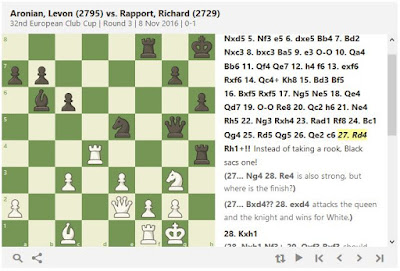
Sam Copeland reporting for Chess.com has the rest of the story.
In other news, the USCF has a Couch Potato's Guide to the World Chess Championship, written by GM Ian Rogers. It's quite a good read, and I recommend it. I may even try the cheesecake recipe.
I also have a couple of comments on the Carlsen-Karjakin match that starts Friday in NYC. First, the games will be at 2 PM Eastern, which is perfect for those of us in the Club.
Second, the betting odds favor Magnus heavily. If you're a betting man (or woman), and have access to a (legal) book, I'd recommend betting on Sergey. Yes, Magnus should be the favorite, but I don't think he should be favored by more than three to one, tops, and possibly only two to one. If I had spare cash and access, I'd bet on Sergey just because I think the EV is good. That said, if I had to be the rent money, I'd bet on Magnus, because he's Magnus. But I've heard the odds are as much as 8 to 1, and that's just absurd.
Finally, one last note. I now have a TD license, and the Club is looking into running some rated events. Perhaps just quick quads or small quick swisses, perhaps ladders, and maybe eventually larger events. We still have a couple of minor administrative issues to work out. We'll let you know when we get going.

Black to move
Sam Copeland reporting for Chess.com has the rest of the story.
In other news, the USCF has a Couch Potato's Guide to the World Chess Championship, written by GM Ian Rogers. It's quite a good read, and I recommend it. I may even try the cheesecake recipe.
I also have a couple of comments on the Carlsen-Karjakin match that starts Friday in NYC. First, the games will be at 2 PM Eastern, which is perfect for those of us in the Club.
Second, the betting odds favor Magnus heavily. If you're a betting man (or woman), and have access to a (legal) book, I'd recommend betting on Sergey. Yes, Magnus should be the favorite, but I don't think he should be favored by more than three to one, tops, and possibly only two to one. If I had spare cash and access, I'd bet on Sergey just because I think the EV is good. That said, if I had to be the rent money, I'd bet on Magnus, because he's Magnus. But I've heard the odds are as much as 8 to 1, and that's just absurd.
Finally, one last note. I now have a TD license, and the Club is looking into running some rated events. Perhaps just quick quads or small quick swisses, perhaps ladders, and maybe eventually larger events. We still have a couple of minor administrative issues to work out. We'll let you know when we get going.
Friday, September 30, 2016
Thoughts on the old FIDE World Championship format
A while back I was reading one of IM John Watson's book review columns at The Week in Chess. This time Watson was reviewing Andre
Schulz's work The
Big Book of World Chess Championships; 46 Title Fights – from
Steinitz to Carlsen (
352 pages; New in Chess 2015). It's a typically lengthy review, and worth reading. (The tl;dr version of the review is that Watson found the book very enjoyable, and recommends it highly.)
Among the other bits Watson culls from the book is this "oddity", as he calls it:
But when I was a young player, even before playing in my first rated tournament I noticed an interesting fact: between the time when Botvinnik won the title in 1948 and Anatoly Karpov's first title defense against Korchnoi in 1978, the reigning World Champion had only won a single match for the world title, when Petrosian defeated Spassky in 1966. (In act, when I first learned of all this history, it was Christmas of 1980, and I didn't actually know that Karpov had defended his title successfully in 1978. I learned all of this from Golombeck's Chess: A History.)
The titles & matches went as follows (defending champion listed first):
That led me to the conclusion in my youth, which I still mostly believe to this day, that unless the Champion is an extremely dominant player, he just can't count on winning a match as Champion. So Karpov and Kasparov were both able to win multiple World Championship matches as Champion, but Kramnik couldn't until he met Topalov, when one Champion had to lose. Anand did, which makes him unique in that he wasn't dominant as Champion, and Carlsen has now done so once, which fits the pattern.
Note too that if one looks at all of the "Classical" list of Champions (plus Topalov), almost half of them have not been able to win a match as Champion: Capablanca, Euwe, Botvinnik, Smyslov, Tal, Spassky, Fischer & Topalov all failed in that quest, while Steinitz, Lasker, Alekhine, Petrosian, Karpov, Kasparov, Kramnik, Anand and Carlsen have succeeded.
Or to quote Ric Flair, "To be The Man, you gotta STAY The Man!" And only about half of Champions have had staying power.
Some additional points to make: Steinitz, Lasker and Alekhine all had the benefit of choosing their own opponents, which helped considerably, though Steinitz was willing to play anyone and everyone. (Capablanca and Euwe also had that option, but they failed to choose wisely!) Kramnik sorta kinda had that option, as did Kasparov for a while, but both did win against duly selected challengers at some point in their careers as Champion.
Since FIDE assumed control of the title following Alekhine's death in 1946, six have failed to defend their titles while only five have succeeded. (I'm excluding Kramnik from this list.) What this has told me is that regular practice against the toughest opponents when one NEEDS to win is the best preparation for a World Championship match. Anything less leaves everything to chance.
Among the other bits Watson culls from the book is this "oddity", as he calls it:
“At the FIDE congress of 1955 in Gothenburg, Botvinnik had submitted several suggestions. Thus the World Champion made efforts to be allowed to play in the candidates’ tournament because he was of the opinion that the qualification cycle conferred an advantage on the challenger for the WCh match, since unlike the inactive title defender he (the challenger) was getting tournament practice."The Patriarch had a point, but not exactly the one he claimed. In Botvinnik's case he wasn't getting much practice because he largely refused to play in anything other than World Championship matches through most of his title reign. That was entirely on him.
But when I was a young player, even before playing in my first rated tournament I noticed an interesting fact: between the time when Botvinnik won the title in 1948 and Anatoly Karpov's first title defense against Korchnoi in 1978, the reigning World Champion had only won a single match for the world title, when Petrosian defeated Spassky in 1966. (In act, when I first learned of all this history, it was Christmas of 1980, and I didn't actually know that Karpov had defended his title successfully in 1978. I learned all of this from Golombeck's Chess: A History.)
The titles & matches went as follows (defending champion listed first):
Botvinnik drew with Bronstein, 1951So the defending Champion's record in World Championship matches throughout this period was a woeful 1+, 6-, 2=, 1 forfeit. Over ten matches the Champion was as likely to forfeit the title in a fit of pique as he was to actually win a title defense. Of the six champions of this period, four couldn't win more than one match, and a fifth (Botvinnik) could only win rematches.
Botvinnik drew with Smyslov, 1954
Botvinnik lost to Smyslov, 1957
Smyslov lost to Botvinnik, 1958
Botvinnik lost to Tal, 1960
Tal lost to Botvinnik, 1961
Botvinnik lost to Petrosian, 1963
Petrosian DEFEATED Spassky, 1966
Petrosian lost to Spassky, 1969
Spassky lost to Fischer, 1972
Fischer forfeited the title to Karpov, 1975
That led me to the conclusion in my youth, which I still mostly believe to this day, that unless the Champion is an extremely dominant player, he just can't count on winning a match as Champion. So Karpov and Kasparov were both able to win multiple World Championship matches as Champion, but Kramnik couldn't until he met Topalov, when one Champion had to lose. Anand did, which makes him unique in that he wasn't dominant as Champion, and Carlsen has now done so once, which fits the pattern.
Note too that if one looks at all of the "Classical" list of Champions (plus Topalov), almost half of them have not been able to win a match as Champion: Capablanca, Euwe, Botvinnik, Smyslov, Tal, Spassky, Fischer & Topalov all failed in that quest, while Steinitz, Lasker, Alekhine, Petrosian, Karpov, Kasparov, Kramnik, Anand and Carlsen have succeeded.
Or to quote Ric Flair, "To be The Man, you gotta STAY The Man!" And only about half of Champions have had staying power.
Some additional points to make: Steinitz, Lasker and Alekhine all had the benefit of choosing their own opponents, which helped considerably, though Steinitz was willing to play anyone and everyone. (Capablanca and Euwe also had that option, but they failed to choose wisely!) Kramnik sorta kinda had that option, as did Kasparov for a while, but both did win against duly selected challengers at some point in their careers as Champion.
Since FIDE assumed control of the title following Alekhine's death in 1946, six have failed to defend their titles while only five have succeeded. (I'm excluding Kramnik from this list.) What this has told me is that regular practice against the toughest opponents when one NEEDS to win is the best preparation for a World Championship match. Anything less leaves everything to chance.
Monday, February 22, 2016
Kasparov on the hunt....
Kasparov provides analysis of his victory over Karpov in game 20 of their 1990 World Championship Match.
Hat tip to David Llada, who linked to this on both his Twitter feed and Facebook feed.
Subscribe to:
Posts (Atom)