Once again we're nearing the annual United States Amateur Team Championship dates. This year the South edition will once again be held in Kissimmee, Florida. (That's basically south Orlando for those that may be reading this but don't know Central Florida. It's Walt Disney World's back yard or front porch, depending on how you want to look at it.)
Once again Jon Haskel of the Boca Raton Chess Club is organizing and directing the event. The tournament flyer can be found here, and other information can be found here. Additionally, over to the right you will see that I have added a page with some of this information, so it can always be found quickly even as this post moves down the page. That page of information can be found at this link.
Be sure to get the word out to anyone that might not here about the tournament through other means, and start putting your teams together! We're already working on ours.
Tuesday, November 28, 2017

Thursday, November 9, 2017
BOOOOOM! MAGNUS!
A French chess livestreamer finds out he's playing Magnus Carlsen online. A Grob is assayed. Hilarity ensues.
H/t Tarjei J. Svensen
H/t Tarjei J. Svensen
Sunday, September 3, 2017
Another Boring Catalan
FIDE's World Cup Tournament kicked off today. The format is 128 players in a knockout format. Agadmator provides some video analysis of a boring Catalan from the first day. I recommend it.
You can find an interview with the player of the White pieces here.
You can find an interview with the player of the White pieces here.
A couple of endgames to ponder
First, a puzzle from LiChess, who take their puzzles from users games. Find the best move for White.

The answer later.
Second, another position with White to move.

Black's ...Kd7-e6 targets White's h-pawn. White clearly has to move his king now. Which way should the White king go?

The answer later.
Second, another position with White to move.

Black's ...Kd7-e6 targets White's h-pawn. White clearly has to move his king now. Which way should the White king go?
Wednesday, August 30, 2017
A crazy game!
Chess.com tweeted a link to a crazy game one of their users, Spektrowski, had posted the other day. Here's a link to the game, with Spektrowski's analysis. I HIGHLY recommend playing through this game, as it is border-line deranged. Just hit the "PLAY" button first, and watch the madness ensue. If you want to play through it more slowly, either to follow Spektrowski's analysis or to analyze it yourself, do that after letting autoplay take you down the rabbit hole.
Tuesday, August 29, 2017
Analysis Time
Here's a tweet from FM Carsten Hansen.
The first two or three moves suggest themselves. Then it gets harder. Add your analysis in the comments, and I'll post the correct line later.
ANALYSIS can be found here.
Zivkovic-Kurajica— Carsten Hansen (@CazHansen) August 27, 2017
Teslic 2006
White to move
White played 21.Rd2 and draw agreed - White can play another move to win. #chess #schach pic.twitter.com/guPQUv610D
The first two or three moves suggest themselves. Then it gets harder. Add your analysis in the comments, and I'll post the correct line later.
ANALYSIS can be found here.
Monday, August 28, 2017
A new book coming soon from Quality Chess
Quality Chess has just sent a new book to the presses, Playing 1.d4 d5 by Nikos Ntirlis. They have also kindly presented a 15 page excerpt to wet our appetites. The excerpt can be found here.
Friday, August 25, 2017
Mate in bunch.
If the answer doesn't make you smile, you either (a) haven't found the right answer, or (b) are dead inside.
Most statisfying chess puzzle ever.
— Johan Salomon (@JohanSalomon) August 23, 2017
White to move and win! 😎 pic.twitter.com/FiMnXCSYKn
Friday, August 11, 2017
Product Review: Internet Chess Club
The tl;dr version is: Skip this product.
Longer:
Issues that had been seemingly resolved 20 years ago are making this site unplayable now. Lag is a big problem for online gaming, and has always been so. Chess sites, back in the early days, developed time seal or time stamp programs to solve this issue. The idea is that moves are stamped with the time of sending, so that if one player is lagging, his clock shouldn't run unless he has received his opponents move, and a corresponding signal would be sent back to the server. Thus the problem was solved for ICC back in the day, or at least ameliorated.
That no longer appears to be the case. I am watching my clock either suddenly lose time when my opponent's move finally gets "delivered", or I am watching my clock run for a LONG time. This even occurs after premoves. I once saw my clock run for 45 seconds on a pre-move. One a #$%ing pre-move!
Needless to say, this is making the site unplayable. There are many other good features on the site, including instructional videos and training programs, but such things are ubiquitous these days. I just don't think it is worth the money to get such things when the actual main feature of the site is [redacted] worthless. I've contacted support, and gotten no actual help on this issue. Perhaps other sites also have this problem, but I haven't PAID other sites, either. Save your money, and don't buy it.
...
It's a real shame to watch the early chess playing sites go completely down the toilet. But they haven't kept up, and their actual coding has gotten worse with experience.
Tuesday, August 8, 2017
Chess is funny
Taking a break from housekeeping today, I reached the following position as Black, with the move. My question is, how would you evaluate the position?

The position arose from a French Exchange variation. I felt pretty good about my prospects here, as I was threatening to win the pawn on d4 in a few moves, and White's play felt too slow on the kingside.
After the game, I backed it up and looked at it to see where my opponent went off the rails. It turns out, it was the move 19 g4. He is now down about the equivalent of a rook! Here's the thing, and the reason I'm posting this: Black doesn't have a big knockout blow here. It's just that his play is very, very easy, and even with the sub-optimal 19...Nf4, I won when my opponent resigned on move 31 with a mate in one on the board. Black looks better, but who would think it was a crushing advantage?
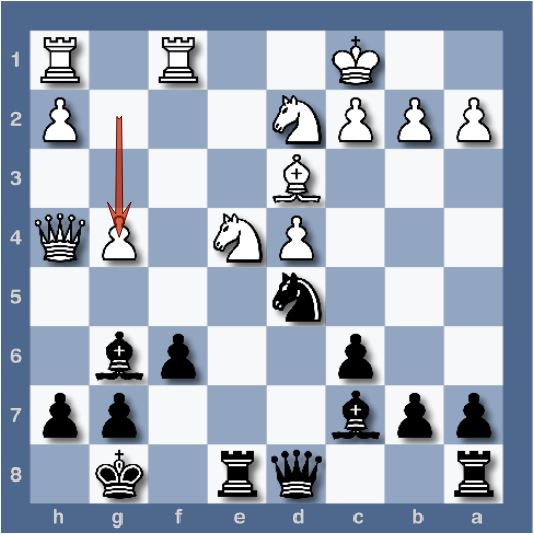
The position arose from a French Exchange variation. I felt pretty good about my prospects here, as I was threatening to win the pawn on d4 in a few moves, and White's play felt too slow on the kingside.
After the game, I backed it up and looked at it to see where my opponent went off the rails. It turns out, it was the move 19 g4. He is now down about the equivalent of a rook! Here's the thing, and the reason I'm posting this: Black doesn't have a big knockout blow here. It's just that his play is very, very easy, and even with the sub-optimal 19...Nf4, I won when my opponent resigned on move 31 with a mate in one on the board. Black looks better, but who would think it was a crushing advantage?
Sunday, August 6, 2017
Orlando Chess at the Sinquefield Cup
Yesterday I saw this tweet from @LiChess and thought, "Don't I know the person sitting next to Rex Sinquefield?"
Today I got confirmation that it was someone I know. Lars & Jen Hansen's Orlando Chess House twitter account tweeted out the following:
It turns out there's quite the Orlando crowd up there!
Man of the people Rex Sinquefield can often be found in the front row of the crowd watching the live broadcast at the chess club. pic.twitter.com/Ufc6xliDG1— Lichess (@lichess) August 5, 2017
Today I got confirmation that it was someone I know. Lars & Jen Hansen's Orlando Chess House twitter account tweeted out the following:
At #SinquefieldCup in St Louis pic.twitter.com/oewKwHn3Ie— Orlando Chess House (@OrlandoChess) August 6, 2017
Enjoying chess with old and new friends at #SinquefieldCup in St Louis pic.twitter.com/KQvppKcJSQ— Orlando Chess House (@OrlandoChess) August 6, 2017
The Orlando crowd hanging out at #SinquefieldCup in St Louis pic.twitter.com/BO1z8gMYDI— Orlando Chess House (@OrlandoChess) August 6, 2017
It turns out there's quite the Orlando crowd up there!
If you're ever looking for a chess shop in Moscow, Russia...
... the ChessOK headquarters might be the place for you! Here's a blog post from Dylan Love at Chess.com about the store. I remember an early version of Chess Assistant on floppy disks being my first data base. The search speeds on CA have alway blown ChessBase out of the water, but CB has had the more popular interface.
Anyway, if you're in Moscow, look 'em up!
Anyway, if you're in Moscow, look 'em up!
Friday, August 4, 2017
Tactics Time at the Sinquefield Cup
In round one of the Sinquefield Cup, Sergey Karjakin smashed Peter Svidler. In his recap for the Internet Chess Club, GM Ronen Har-Zvi spotted an incredible tactic that COULD have occurred. Here's the position, with White to move:
 Take a look at see if you can work it out. I was able to spot the relevant ideas, but couldn't put them all together. I really enjoyed this combination, and hope you do as well. You can follow along with the video from the correct time here.
 Take a look at see if you can work it out. I was able to spot the relevant ideas, but couldn't put them all together. I really enjoyed this combination, and hope you do as well. You can follow along with the video from the correct time here.
Sunday, July 30, 2017
A King on the Rampage
Yesterday at the Club Todd Durham and I were looking at some of his games, and one game had him with a bishop and knight vs two knights. The ending was very interesting and ended in a draw, but in the course of analyzing it we talked about the concept of king activity.
I have read multiple times (but now can't find the exact references) that the normal sequence of activating pieces in an endgame should be:
1. Queen
2. Rooks
3. King
4. Knights
5. Bishops
I am in the midst of re-reading GM Lars Bo Hansen's Foundations of Chess Strategy (absorbing ideas on the second pass that I missed in the first), and unfortunately it was not until I was in the car on the way home that I remembered the MOAKE (mother of all king endings) known around the world as Browne-Smyslov, Las Palmas Interzonal, 1982.
It prompted a little research when I got home, and I found three books with annotations to the game. They are:
Foundations of Chess Strategy by GM Lars Bo Hansen
Vasily Smyslov: Endgame Virtuoso by GM and Former World Champions Vasily Smyslov
The New Bogo-Indian by IM Shaun Taulbut
I suspect that I could also find it in other books, but three will suffice for us here.
The link to the game is below. I extracted commentary from the above games, citing the author in each case, and I added some "merely mortal" comments where I thought there was an additional idea worth noting.
Before we go to the game, I would like to intentionally bias your viewpoint by recommending that the following ideas be kept in mind:
1) Economy of force is an under-appreciated commodity in chess. We understand economy of force when applied to defense, but it is rare to see it involved in an attack. Enjoy it when you can!
2) Prophylaxis can also be an offensive weapon, if it prevents potential defensive forces from participating in the action.
3) Smyslov is what we "Hansenites" refer to as a Reflector, but even though he is very positional in the game, his moves have very concrete purposes. His king moves with energy and purpose throughout the game, completely devoid of stereotyped thinking.
4) Smyslov was 63 when the game was played. Throw your senior stereotypes out the window!
Enough blabber- here is the game!:
Click here to see Smyslov's King kick #$^5434!!
Monday, July 24, 2017
Beat Your Opponents with a Club!
Beat Your Opponents With A Club!
A chess club, that is!
This weekend I played in the Southern Open in Orlando, sponsored by the Continental Chess Association and directed by David Hater, Krista Alton, Harvey Lerman, and Harold Scott.
[My last round game (the $$ game) is linked at the bottom. The GM games in the notes are really cool, and worth seeing alone.]
The attendance was huge, and the event was an extremely well-run affair. Harold Scott gets a special "shout out" for details such as updating the results sheets in almost "real time", so it was always easy to see how rounds were progressing as games ended.
I attended the event with my fellow Clermont Chess Clubmates Todd Durham, Jim McTigue, and Connor Eickelman. I was fortunate to score 3.5/5 in the U2100 section, which was good for the U1900 1st prize of $500- the full payout, as the tournament paid 100% due to the excellent attendance.
I have been especially fortunate in that it is my second 1st place finish in as many months (I had a stinker tournament in the middle - gotta keep it real!). Luck is a big factor, of course, whether we admit it or not.
However, I attribute my primary success to two factors. First, I have been a big beneficiary of the arrival of GM Lars Bo Hansen and WIM Jen Hansen to Orlando- and I am not the only one. Attending some of his Master Class sessions, and then especially working with his books, has changed my thinking and approach to the game. I am the same person, but I am not the same player.
Second, I am very fortunate to belong to a chess club that meets regularly, and to work with other players who share my passion for chess and learning. The three guys mentioned above, along with Norm Meintel, Joe Sanderlin, and Garry Day, have been my constant sparring partners.
Our club is not a normal club. For one, we are more talkative than usual. We want to get better, and we collaborate on our work. In fact, the Thursday before the tournament, the four of us who planned to play met on Thursday night and discussed positions from GM Chris Ward's Chess Choice Challenge, which gives positions with 5 different assessments, and you have to decide which one is correct (a concept I was introduced to by Lars, I should add). We would look at a quiz position, we would each weigh in on it, then we would check the answer and discuss/debated it. It was a great way to get the creative chess juices flowing, and both times we have done it, I have been successful- to the tune of $1100 in prize money in 45 days.
My point is this- working with my buds at the club makes me a better player. We kibbitz all the time, we play into each other's openings to help each other learn, we work on endgames (read that again!) and we give each other honest feedback to help us all improve. I also play on the internet, but it is not the same- there is no substitute for sitting across the board from someone and playing a person, not an engine, an icon, or emoji.
If you live close by, come by and see us. If not, find a club or start one of your own. Here's a link that might help:
And as I mentioned, here is my final round game from the tournament.
Subscribe to:
Posts (Atom)