Back in February, club stalwart Garry Day had an unusual result at the USATS: he played five games, at the end of which his rating was completely unchanged.
Over the last weekend, club semi-regular Theo Slade had an even more peculiar result: over eight games at the World Open, his rating was also unchanged. Perhaps this is more common because of the new rating formula they instituted a few years back?
Theo is having a busy summer, BTW. He played in the Summer Solstice Open and the Orlando Sunshine Open in back-to-back weekends at the start of June, and he's playing the World Open and the Philadelphia International Open back to back this week. If you've got the FollowChess app on your phone or tablet, you can follow his games live.
Showing posts with label Garry Day. Show all posts
Showing posts with label Garry Day. Show all posts
Friday, July 8, 2016

Thursday, March 24, 2016
Queen plus pawns versus Rook plus Bishop plus pawns, Part 2 [UPDATED]
Update is below the fold.
In the previous post I presented an endgame study. The solution is below the fold. First a digression on this type endgame. The original position was

It was White to play, though that's probably not critical for assessing the position. We thought this was probably a draw, as it looks like Black should be able to construct a fortress easily enough. But we decided to consult Garry's 2003 revised edition of Reuben Fine's Basic Chess Endings. The section "Queen vs. Rook and One Minor Piece" said the following:
When I got home, I checked Muller & Lamprecht's Fundamental Chess Endings, but that book was silent on the issue, as were Dvoretsky's Endgame Manual and Paul Keres's Practical Chess Endings. Fine states that this is a win, and in 2003 Benko agreed with him. No one else says anything about it. (If anyone can consult Averbakh's endgame encyclopedia, or something from Informant, let me know.) So how to go about winning a position like the one above? I have no idea if the R+B side plays correctly. Feel free to give it a try, and add any research in the comment section below. Alternately, present it at the club. But this one is a bear.
I will also look in my database for similar positions, but not tonight as it's already passing 2am. Maybe Paul or Connor will do it for me!
Now for the solution to the study I gave in the previous post.
In the previous post I presented an endgame study. The solution is below the fold. First a digression on this type endgame. The original position was
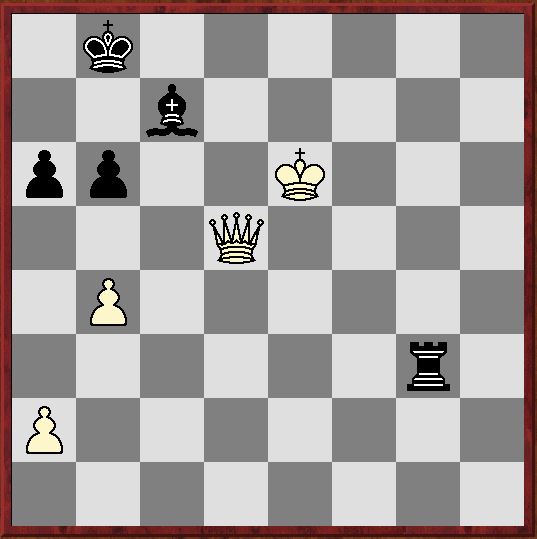
It was White to play, though that's probably not critical for assessing the position. We thought this was probably a draw, as it looks like Black should be able to construct a fortress easily enough. But we decided to consult Garry's 2003 revised edition of Reuben Fine's Basic Chess Endings. The section "Queen vs. Rook and One Minor Piece" said the following:
Without Pawns the ending is a draw, though it is to be expected that there will be problem positions where one side or the other may win.He then follows it up with three examples, all of which have pawns on both sides of the board, or asymmetric pawns. Thus they were all useless for properly assessing our situation.
With Pawns, the Queen is equivalent to R+B+P. If the Pawns are even, the Queen will win (though not without difficulty); but R, B and two pawns are required to conquer the Q.
Where the pawns are even, the win is easier for the Q if they are not balanced. For then the superior side will be able to set up a passed Pawn and capture one of the opponent's pieces or tie him up so badly that some other part of the board will be defenseless.
When I got home, I checked Muller & Lamprecht's Fundamental Chess Endings, but that book was silent on the issue, as were Dvoretsky's Endgame Manual and Paul Keres's Practical Chess Endings. Fine states that this is a win, and in 2003 Benko agreed with him. No one else says anything about it. (If anyone can consult Averbakh's endgame encyclopedia, or something from Informant, let me know.) So how to go about winning a position like the one above? I have no idea if the R+B side plays correctly. Feel free to give it a try, and add any research in the comment section below. Alternately, present it at the club. But this one is a bear.
I will also look in my database for similar positions, but not tonight as it's already passing 2am. Maybe Paul or Connor will do it for me!
Now for the solution to the study I gave in the previous post.
Queen plus pawns versus Rook plus Bishop plus pawns, Part 1
Garry and I played a few games tonight and the ending with Queen & three pawns versus Rook, Bishop & two pawns came up in a game. The Queen & pawns won easily enough. So we started looking at the ending withjust two pawns for the side with the Queen. We arrived at this position:

I thought I had a winning plan with 1 Qg8+ Ka7 2 Qc8. Was I correct that this was a winning line? If not, can White's play be improved?
I will give the answers in the following post.

White to play
I thought I had a winning plan with 1 Qg8+ Ka7 2 Qc8. Was I correct that this was a winning line? If not, can White's play be improved?
I will give the answers in the following post.
Subscribe to:
Posts (Atom)