Showing posts with label Keres. Show all posts
Showing posts with label Keres. Show all posts
Tuesday, August 30, 2016
Speaking of the article on Keres...
In the previous post I discussed an article Chess24 had published on Keres. I hadn't read it then, but I have now. If you're a fan of Keres or chess history, I highly recommend it. And not only is the article to be commended for its content, but Chess24 has done an outstanding job with the format. One can click on the games mentioned in the text and not only play through them, but play through them with a chess engine to provide analysis. The interested reader can even supply his own moves and see how the computer evaluates them. Chess24 has really pushed chess publishing online forward another step.

Speaking of Keres...
In the last post I briefly mentioned Paul Keres. It so happens this year is the centenary of his birth, and to mark the occasion, Chess24.com will be publishing a series of articles. Their introduction to the series:
To mark [Keres's] centenary his compatriot Joosep Grents looks back on the life and career of the “Eternal Second”, starting with Keres’ early years until his explosion onto the international scene at the 1935 Olympiad.The author's introduction to the piece presents what he hopes to accomplish:
To mark the Year of Paul Keres, in the following months I’m aiming to publish a series of articles shedding light on the events of his life. A lot has been written about a player who was prevented from playing a World Championship match against Alexander Alekhine by World War II, and who Chessmetrics report was ranked world no. 2 for 52 different months between 1943 and 1960. The material available in English, however, is limited. Most extensive biographies – and literature going beyond mere game collections – has been published in Estonian, and mostly by Keres’ biographer Valter Heuer. This has not, to my knowledge, been translated into English. The motivation for these articles is therefore not only to celebrate the centenary of Keres’ birth, but also to open up literature that may not be available to non-Estonian speakers.I haven't read the first article yet, as it's long and I have a six year-old to chase, but it looks promising. And those with an interest in Keres's games should check the club library. Keres's wrote three collections of his games, and the single-volume English translation by Golumbek is up on the shelf. The books (or book in this case) are simply outstanding. There are two downsides to the volume, however. First, it is the size of a standard paperback novel, and thus doesn't lay flat when open. (The collection is quite large.) Second, it is in the old English Descriptive Notation. That's not a problem for me, but I know some of you break out into hives at the thought of it. So, fair warning!
Monday, August 29, 2016
Show you drawing zone? I show you drawing zone!
After the simul on Saturday, I played a few blitz games against Hleb. The results were as expected. However, in analysis after one of the games, we determined that we could have reached a Q+P vs Q ending, with Hleb having the extra pawn - on a rook file.
For some reason or another I had been looking at that ending a few months back, and I remembered that the "drawing zone" could be surprisingly large for the weaker side. I couldn't prove this, though, as (a) I'm not good at this kind of technical exercise, (b) I didn't actually remember anything I had (maybe) learned, and (c) Hleb outrates me by 400 points. But I kept repeating that "There's a drawing zone!" and Hleb would reply "Show me drawing zone!"
Now that I'm home and can look things up, I will show you drawing zone! Muller & Lamprecht's Fundamental Chess Endings shows a couple of examples.


In both cases, if Black has the move and his king is on one of the squares highlighted in green, it is a tablebase draw. But if you want the proof, you'll have to look it up elsewhere, or investigate the positions yourself!
I will add this, however: in the case of the a7 pawn, according to Muller & Lamprecht, "... h8 is a draw for specific tactical reasons, and does not constitute a drawing zone in the normal sense."
...
It seems that this ending had not merited much attention from GMs in the past. Reuben Fine in Basic Chess Endings (1941) simply states, "A RP draws just as easily as a KtP: once the Pawn gets to R7, the K to R8, perpetual check is unavoidable."
Paul Keres in Practical Chess Endings (1973, West Germany) Was slightly wordier in his exposition: "We shall not examine positions involving the RP, which only offer White slender winning chances. The reason for this is clear: White's king has difficulty escaping checks."
And of course, all of this reminded me of an anecdote from a tournament played over 40 years ago. In the 1975 Hoogovens Tournament in Wijk aan Zee, the following position was reached in the seventh round:

I'll pick up with Kavalek's notes, from R.H.M.'s tournament book:
Incidentally, Kavalek's book for R.H.M. on the 1975 Wijk aan Zee grandmasters tournament is my favorite tournament book of all time. Eleven of the sixteen players contributed some notes to the games, and Kavalek annotated a great many others. But Kavalek's notes before each game are what really make the book a winner, as it gives a good "slice of life" look at such a tournament. If you come across a copy somewhere, I'd recommend picking it up.
For some reason or another I had been looking at that ending a few months back, and I remembered that the "drawing zone" could be surprisingly large for the weaker side. I couldn't prove this, though, as (a) I'm not good at this kind of technical exercise, (b) I didn't actually remember anything I had (maybe) learned, and (c) Hleb outrates me by 400 points. But I kept repeating that "There's a drawing zone!" and Hleb would reply "Show me drawing zone!"
Now that I'm home and can look things up, I will show you drawing zone! Muller & Lamprecht's Fundamental Chess Endings shows a couple of examples.

Q + a5P vs Q

Q + a7P vs Q
In both cases, if Black has the move and his king is on one of the squares highlighted in green, it is a tablebase draw. But if you want the proof, you'll have to look it up elsewhere, or investigate the positions yourself!
I will add this, however: in the case of the a7 pawn, according to Muller & Lamprecht, "... h8 is a draw for specific tactical reasons, and does not constitute a drawing zone in the normal sense."
...
It seems that this ending had not merited much attention from GMs in the past. Reuben Fine in Basic Chess Endings (1941) simply states, "A RP draws just as easily as a KtP: once the Pawn gets to R7, the K to R8, perpetual check is unavoidable."
Paul Keres in Practical Chess Endings (1973, West Germany) Was slightly wordier in his exposition: "We shall not examine positions involving the RP, which only offer White slender winning chances. The reason for this is clear: White's king has difficulty escaping checks."
And of course, all of this reminded me of an anecdote from a tournament played over 40 years ago. In the 1975 Hoogovens Tournament in Wijk aan Zee, the following position was reached in the seventh round:
Jan Smejkal (2600) vs Walter Browne (2550)

After 57 ... Kc6-b5
I'll pick up with Kavalek's notes, from R.H.M.'s tournament book:
Here the game was adjourned for the second time.Walter reportedly said that he did not know how Smejkal could advance his pawn. But what seemed hard for the American was easy for the Czech. I recommend that you be patient and watch Smejkal's winning technique. It looks rather convincing, even though according to some opinions Black could have had good drawing chances.So, some practical difficulties exist!
A week after this tournament was over the Yugoslav Grandmaster Ljubomir Ljubojevic gave a clock exhibition in a small Dutch town. After five hours one game had to be adjudicated. Each player had a queen on the board and Ljubo had one pawn: it was a KRP on the fifth rank. The result was a draw but somebody pointed out that the same position was won by Smejkal against Walter Browne. The master who called Ljubo's game a draw said, "But that's impossible! How did he win it?"
Incidentally, Kavalek's book for R.H.M. on the 1975 Wijk aan Zee grandmasters tournament is my favorite tournament book of all time. Eleven of the sixteen players contributed some notes to the games, and Kavalek annotated a great many others. But Kavalek's notes before each game are what really make the book a winner, as it gives a good "slice of life" look at such a tournament. If you come across a copy somewhere, I'd recommend picking it up.
Thursday, July 28, 2016
Another ongoing discussion, this time concerning central pawn expansion in the QGD
Recently Paul Leggett and I have been discussing a plan created by Botvinnik in the QGD, in which as White he forgoes the minority attack of yore (even back then!) and instead plays for central expansion. The key line runs 1 d4 d5 2 c4 e6 3 Nc3 Nf6 4 cxd5 exd5 5 Bg5 Be7 6 e3 0-0 7 Bd3 Nbd7 8 Qc2 Re8 and now 9 Nge2 with the plan of castling, tucking away the king, and then an eventual f2-f3 and e3-e4, gaining much space in the center and kingside. This plan was first seen, I believe, in Botvinnik-Keres, USSR Ch (Moscow) 1952. (The move order given above is a transposition.)
Prior to that, 9 Nge2 had occurred in this position nine times. According to Kasparov's MGP series, Botvinnik had the following to say after the additional two-ply of 9...Nf8 10 0-0:

Paul brought this up within the context of a recent game of his, which he posted on Facebook*. Later in the discussion, Paul made the following comment:
Alas, my abilities to visualize the action were sadly lacking. On vacation a few days ago I managed to finally get to the game, which goes as follows: 1 d4 d5 2 c4 c6 3 e3 Nf6 4 Nc3 Bf5 5 cxd5 Nxd5 (a key difference in pawn structures!) 6 Bc4 e6 7 Nge2 (our star move) Nd7 8 0-0 Qh4, and now Rubinstein committed a tactical oversight and played 9 e4, which simply lost a pawn.
But in the tournament book, Alekhine made the following comment about this position:

It's hard to believe that Botvinnik wasn't aware of both the game and Alekhine's commentary on the game, and perhaps it inspired him. Probably not in 1952, but rather in 1938, against another one of the giants of the game. For the famous Botvinnik-Capablanca game at the renowned AVRO tournament featured Botvinnik playing 9 Nge2 with an eventual 0-0, f2-f3 and e3-e4 against Black's pawns on the a-d files and an absent Black e-pawn.
I rather imagine, sans any evidence, that this was all a chain of inspiration over time, one thing leading naturally to another. It makes for a nice story, but I have no idea how much if any validity it merits. I do know that in his book One Hundred Selected Games Botvinnik mentions as early as Black's sixth move in the Capablanca game that White's basic plan is to play f2-f3 and e3-e4, breaking through in the center. He goes on to mention after 9 Nge2 that the game recalls Lilienthal-Ragozin, Moscow 1935, but with a couple of minor differences. Clearly Botvinnik had given this strategical idea some thought!
Those with better paper archives might find more on the genesis of the Nge2, 0-0, f2-f3, e3-e4 idea in these structures, and of Botvinnik's inspiration. (I only have three books by Botvinnik, the one mentioned which only covers games up until 1946, Championship Chess on the Absolute Soviet Championship of 1941, and a book that he sorta kinda maybe co-authored on the Grunfeld Defense in the 1970s, so I have nothing by him on his games against Keres or Larsen save what Kasparov quotes.) And those with better db skills may well turn up some stones plowing fields of data.
So for now, I leave it at that.
...
But I do have two additional comments of a tangential nature. First, the Rubinstein-Bogoljubov game, and Alekhine's notes to it, have more interesting features, which I hope to return to soon. Second, can you imagine one of the top players now writing a tournament book? Imagine Carlsen or Giri writing notes to the recent BilBao tournament, for example, which was also a six player double round robin. Come on, guys, it's only 30 games, and I'm sure your seconds will kick in a good deal of the work. Let's make tournament books great again!
* I hope that's the correct link. Facebook is a real pain in the posterior to deal with on such matters.
Prior to that, 9 Nge2 had occurred in this position nine times. According to Kasparov's MGP series, Botvinnik had the following to say after the additional two-ply of 9...Nf8 10 0-0:
This continuation was unusual for that time. After Ng1-f3 White normally used to castle on the kingside, whereas when he played Ng1-e2 he would castle queenside. But in the present game a 'hybrid' variation has been employed, with the aim of making it difficult for the opponent to choose a plan. After White's kindside castling it is harder for Black to obtain active play, in which Keres always felt confident. - M. Botvinnik(That idea of Nge2, castling queenside and then attacking the kingside with pawns still had some poison in it at the top levels into the early 1980s, by the by.)

Botvinnik-Keres, USSR Ch (Moscow) 1952
after 9 Nge2
Paul brought this up within the context of a recent game of his, which he posted on Facebook*. Later in the discussion, Paul made the following comment:
I am almost finished reading "Rubinstein Move by Move" by GM Zenon Franco (an excellent book), and what do I find towards the end of the book? Botvinnik-Keres 1952 and Kasparov-Andersson 1988, annotated in the context of Rubinstein's contribution to the QGD. These games will live forever.To which I replied that I had just noticed the game Rubinstein-Bogoljubov, London 1922, which seemed to be heading in the direction of the Botvinnik game above, but after playing Nge2, Rubinstein then played e3-e4 followed by f2-f4. It seemed that Rubinstein was going for a direct kingside attack. (I have no idea if this game is mentioned Franco's book. I'm sure Paul can give an answer to that one.)
Alas, my abilities to visualize the action were sadly lacking. On vacation a few days ago I managed to finally get to the game, which goes as follows: 1 d4 d5 2 c4 c6 3 e3 Nf6 4 Nc3 Bf5 5 cxd5 Nxd5 (a key difference in pawn structures!) 6 Bc4 e6 7 Nge2 (our star move) Nd7 8 0-0 Qh4, and now Rubinstein committed a tactical oversight and played 9 e4, which simply lost a pawn.
But in the tournament book, Alekhine made the following comment about this position:

Rubinstein-Bogoljubov, London 1922
after 8 ... Qh4
An inoffensive reply to which White should simply play 9 f3, and if 9...Bd6 10 g3 and Black is forced to withdraw his queen to e7, for if 10...Qh3 11 e4 Nxc3 12 bxc3 Bg6 13 e5 followed by 14 Nf4 and wins. - A. AlekhineClearly Alekhine was looking to central expansion here, and I imagine that he believed that was Rubinstein's original intent. But that knight on d5 induced a tactical error!
It's hard to believe that Botvinnik wasn't aware of both the game and Alekhine's commentary on the game, and perhaps it inspired him. Probably not in 1952, but rather in 1938, against another one of the giants of the game. For the famous Botvinnik-Capablanca game at the renowned AVRO tournament featured Botvinnik playing 9 Nge2 with an eventual 0-0, f2-f3 and e3-e4 against Black's pawns on the a-d files and an absent Black e-pawn.
I rather imagine, sans any evidence, that this was all a chain of inspiration over time, one thing leading naturally to another. It makes for a nice story, but I have no idea how much if any validity it merits. I do know that in his book One Hundred Selected Games Botvinnik mentions as early as Black's sixth move in the Capablanca game that White's basic plan is to play f2-f3 and e3-e4, breaking through in the center. He goes on to mention after 9 Nge2 that the game recalls Lilienthal-Ragozin, Moscow 1935, but with a couple of minor differences. Clearly Botvinnik had given this strategical idea some thought!
Those with better paper archives might find more on the genesis of the Nge2, 0-0, f2-f3, e3-e4 idea in these structures, and of Botvinnik's inspiration. (I only have three books by Botvinnik, the one mentioned which only covers games up until 1946, Championship Chess on the Absolute Soviet Championship of 1941, and a book that he sorta kinda maybe co-authored on the Grunfeld Defense in the 1970s, so I have nothing by him on his games against Keres or Larsen save what Kasparov quotes.) And those with better db skills may well turn up some stones plowing fields of data.
So for now, I leave it at that.
...
But I do have two additional comments of a tangential nature. First, the Rubinstein-Bogoljubov game, and Alekhine's notes to it, have more interesting features, which I hope to return to soon. Second, can you imagine one of the top players now writing a tournament book? Imagine Carlsen or Giri writing notes to the recent BilBao tournament, for example, which was also a six player double round robin. Come on, guys, it's only 30 games, and I'm sure your seconds will kick in a good deal of the work. Let's make tournament books great again!
* I hope that's the correct link. Facebook is a real pain in the posterior to deal with on such matters.
Sunday, July 10, 2016
Sound advice from the immortals
I feel good about this, because it's similar to something I had noticed on my own. "[A]n opponent already wasting time is likely to keep doing so." - see note to White's eleventh move.Spassky takes Bronstein's cunning advice.— Jonathan Manley (@KingpinEd) July 10, 2016
Spassky's 100 Best Games (1972), pp.182-3. pic.twitter.com/NYcG6UD91p
Thursday, March 24, 2016
Queen plus pawns versus Rook plus Bishop plus pawns, Part 2 [UPDATED]
Update is below the fold.
In the previous post I presented an endgame study. The solution is below the fold. First a digression on this type endgame. The original position was

It was White to play, though that's probably not critical for assessing the position. We thought this was probably a draw, as it looks like Black should be able to construct a fortress easily enough. But we decided to consult Garry's 2003 revised edition of Reuben Fine's Basic Chess Endings. The section "Queen vs. Rook and One Minor Piece" said the following:
When I got home, I checked Muller & Lamprecht's Fundamental Chess Endings, but that book was silent on the issue, as were Dvoretsky's Endgame Manual and Paul Keres's Practical Chess Endings. Fine states that this is a win, and in 2003 Benko agreed with him. No one else says anything about it. (If anyone can consult Averbakh's endgame encyclopedia, or something from Informant, let me know.) So how to go about winning a position like the one above? I have no idea if the R+B side plays correctly. Feel free to give it a try, and add any research in the comment section below. Alternately, present it at the club. But this one is a bear.
I will also look in my database for similar positions, but not tonight as it's already passing 2am. Maybe Paul or Connor will do it for me!
Now for the solution to the study I gave in the previous post.
In the previous post I presented an endgame study. The solution is below the fold. First a digression on this type endgame. The original position was
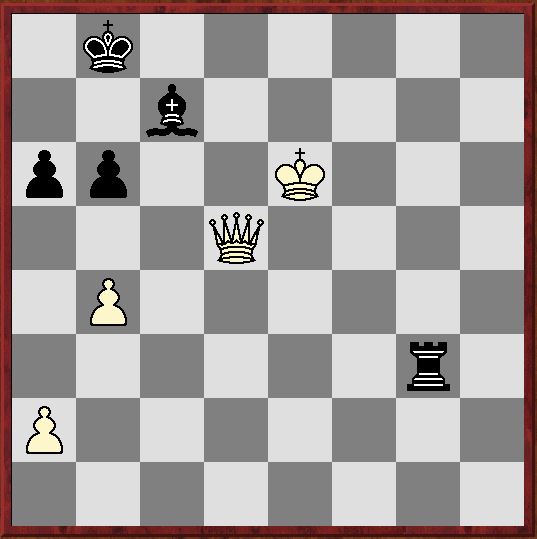
It was White to play, though that's probably not critical for assessing the position. We thought this was probably a draw, as it looks like Black should be able to construct a fortress easily enough. But we decided to consult Garry's 2003 revised edition of Reuben Fine's Basic Chess Endings. The section "Queen vs. Rook and One Minor Piece" said the following:
Without Pawns the ending is a draw, though it is to be expected that there will be problem positions where one side or the other may win.He then follows it up with three examples, all of which have pawns on both sides of the board, or asymmetric pawns. Thus they were all useless for properly assessing our situation.
With Pawns, the Queen is equivalent to R+B+P. If the Pawns are even, the Queen will win (though not without difficulty); but R, B and two pawns are required to conquer the Q.
Where the pawns are even, the win is easier for the Q if they are not balanced. For then the superior side will be able to set up a passed Pawn and capture one of the opponent's pieces or tie him up so badly that some other part of the board will be defenseless.
When I got home, I checked Muller & Lamprecht's Fundamental Chess Endings, but that book was silent on the issue, as were Dvoretsky's Endgame Manual and Paul Keres's Practical Chess Endings. Fine states that this is a win, and in 2003 Benko agreed with him. No one else says anything about it. (If anyone can consult Averbakh's endgame encyclopedia, or something from Informant, let me know.) So how to go about winning a position like the one above? I have no idea if the R+B side plays correctly. Feel free to give it a try, and add any research in the comment section below. Alternately, present it at the club. But this one is a bear.
I will also look in my database for similar positions, but not tonight as it's already passing 2am. Maybe Paul or Connor will do it for me!
Now for the solution to the study I gave in the previous post.
Subscribe to:
Posts (Atom)