Showing posts with label Muller & Lamprecht. Show all posts

Wednesday, September 7, 2016

Tricks with Knights & Rooks

In an earlier post, I had a messy position from the Eickelman-Slade game in the club championship. Working my way through it I came to a position wherein White has to win with a Rook, g- & h-pawns versus a Knight & h-pawn. It turned out that winning the position wasn't too hard, but it put me in mind of the famous Em. Lasker-Ed. Lasker game from the New York, 1924 tournament. Looking up that position in my trusty copy of Fundamental Chess Endings, I came across the following study.

J. Moravec, La Strategie, 1913
White to move and win

This will eventually resolve itself into a R vs N endgame. If the knight is close to the king, the defending side can often draw the game, as in the Lasker-Lasker game above. However, sometimes the knight can be separated from the king, even when they're close together at the start. To see some endgame magic, check below the fold for the solution.

Monday, August 29, 2016

Show you drawing zone? I show you drawing zone!

After the simul on Saturday, I played a few blitz games against Hleb. The results were as expected. However, in analysis after one of the games, we determined that we could have reached a Q+P vs Q ending, with Hleb having the extra pawn - on a rook file.

For some reason or another I had been looking at that ending a few months back, and I remembered that the "drawing zone" could be surprisingly large for the weaker side. I couldn't prove this, though, as (a) I'm not good at this kind of technical exercise, (b) I didn't actually remember anything I had (maybe) learned, and (c) Hleb outrates me by 400 points. But I kept repeating that "There's a drawing zone!" and Hleb would reply "Show me drawing zone!"

Now that I'm home and can look things up, I will show you drawing zone! Muller & Lamprecht's Fundamental Chess Endings shows a couple of examples.

Q + a5P vs Q

Q + a7P vs Q

In both cases, if Black has the move and his king is on one of the squares highlighted in green, it is a tablebase draw. But if you want the proof, you'll have to look it up elsewhere, or investigate the positions yourself!

I will add this, however: in the case of the a7 pawn, according to Muller & Lamprecht, "... h8 is a draw for specific tactical reasons, and does not constitute a drawing zone in the normal sense."

...

It seems that this ending had not merited much attention from GMs in the past. Reuben Fine in Basic Chess Endings (1941) simply states, "A RP draws just as easily as a KtP: once the Pawn gets to R7, the K to R8, perpetual check is unavoidable."

Paul Keres in Practical Chess Endings (1973, West Germany) Was slightly wordier in his exposition: "We shall not examine positions involving the RP, which only offer White slender winning chances. The reason for this is clear: White's king has difficulty escaping checks."

And of course, all of this reminded me of an anecdote from a tournament played over 40 years ago. In the 1975 Hoogovens Tournament in Wijk aan Zee, the following position was reached in the seventh round:

Jan Smejkal (2600) vs Walter Browne (2550)
 After 57 ... Kc6-b5

I'll pick up with Kavalek's notes, from R.H.M.'s tournament book:
Here the game was adjourned for the second time.Walter reportedly said that he did not know how Smejkal could advance his pawn. But what seemed hard for the American was easy for the Czech. I recommend that you be patient and watch Smejkal's winning technique. It looks rather convincing, even though according to some opinions Black could have had good drawing chances.

A week after this tournament was over the Yugoslav Grandmaster Ljubomir Ljubojevic gave a clock exhibition in a small Dutch town. After five hours one game had to be adjudicated. Each player had a queen on the board and Ljubo had one pawn: it was a KRP on the fifth rank. The result was a draw but somebody pointed out that the same position was won by Smejkal against Walter Browne. The master who called Ljubo's game a draw said, "But that's impossible! How did he win it?"
So, some practical difficulties exist!

Incidentally, Kavalek's book for R.H.M. on the 1975 Wijk aan Zee grandmasters tournament is my favorite tournament book of all time. Eleven of the sixteen players contributed some notes to the games, and Kavalek annotated a great many others. But Kavalek's notes before each game are what really make the book a winner, as it gives a good "slice of life" look at such a tournament. If you come across a copy somewhere, I'd recommend picking it up.

Thursday, March 24, 2016

Queen plus pawns versus Rook plus Bishop plus pawns, Part 2 [UPDATED]

Update is below the fold.

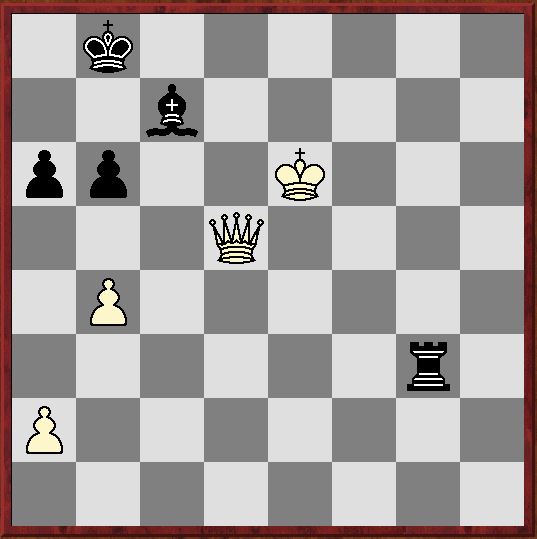
In the previous post I presented an endgame study. The solution is below the fold. First a digression on this type endgame. The original position was


It was White to play, though that's probably not critical for assessing the position. We thought this was probably a draw, as it looks like Black should be able to construct a fortress easily enough. But we decided to consult Garry's 2003 revised edition of Reuben Fine's Basic Chess Endings. The section "Queen vs. Rook and One Minor Piece" said the following:
Without Pawns the ending is a draw, though it is to be expected that there will be problem positions where one side or the other may win.

With Pawns, the Queen is equivalent to R+B+P. If the Pawns are even, the Queen will win (though not without difficulty); but R, B and two pawns are required to conquer the Q.

Where the pawns are even, the win is easier for the Q if they are not balanced. For then the superior side will be able to set up a passed Pawn and capture one of the opponent's pieces or tie him up so badly that some other part of the board will be defenseless.
He then follows it up with three examples, all of which have pawns on both sides of the board, or asymmetric pawns. Thus they were all useless for properly assessing our situation.

When I got home, I checked Muller & Lamprecht's Fundamental Chess Endings, but that book was silent on the issue, as were Dvoretsky's Endgame Manual and Paul Keres's Practical Chess Endings. Fine states that this is a win, and in 2003 Benko agreed with him. No one else says anything about it. (If anyone can consult Averbakh's endgame encyclopedia, or something from Informant, let me know.) So how to go about winning a position like the one above? I have no idea if the R+B side plays correctly. Feel free to give it a try, and add any research in the comment section below. Alternately, present it at the club. But this one is a bear.

I will also look in my database for similar positions, but not tonight as it's already passing 2am. Maybe Paul or Connor will do it for me!

Now for the solution to the study I gave in the previous post.

Wednesday, October 7, 2015

A Nasty Problem: Solution Time!

Last week I published the following nasty problem:

V. Halberstadt, 1938
White to play and win
4N3/3nP3/1k6/8/1K6/8/8/8 w - - 0 1

I had found the problem looking through Karsten Muller & Frank Lamprecht's Fundamental Chess Endings, where they used this a five star (extremely difficult) exercise.

(Solution below the fold.)

Wednesday, September 30, 2015

A nasty problem

I was browsing through my copy of Karsten Muller & Frank Lamprecht's Fundamental Chess Endings a couple of days ago and opened it up to the following exercise, which they give ***** ("extremely difficult"):
V. Halberstadt, 1938
White to play and win
4N3/3nP3/1k6/8/1K6/8/8/8 w - - 0 1

The solution in the back identifies this as a study by V. Halberstadt, and that it shared the first & second prize in 1938 in Gros. No idea what Gros was or is, possibly a magazine? Anyhow, I found it to be an entertaining puzzle, and while I eventually worked out what the first move had to be, I couldn't work my way to the solution.

I'll post the solution in a week or so*. In the meantime, happy hunting!

* A reasonably good program should find the answer quickly, for those that can't wait.