Showing posts with label Todd Durham. Show all posts

Thursday, May 24, 2018

A Small Miss

In a tournament game a couple of weeks back I reached the following position as White, with Black to play:
Black to move

Here Black played 1 … Kc4 and after 2 g4 the game was quickly decided. I had already seen this breakthrough during the exchanges leading up to this position, so it was easy to play.

But I believe Black had a better practical try, namely 1 … f5. Surprisingly, White has one and only one path to victory, and he can even lose if he gets very careless. I will put the solution below the fold.

Sunday, November 27, 2016

Crushing disappointment? No, a ray of sunshine!

Last Saturday, November 19, 2016, Paul Leggett and I trekked over to Daytona for the November Chess Challenge, put on by Stephen Lampkin. It was a good tournament for both Paul and me, as we both picked up about 70 rating points on our regular ratings. Additionally, I finished second, and beat my first master in a rated game. Woo hoo!

But I'm not here to write about any of the good stuff. I'm here to write about my sole loss from the tournament, against FM Jorge Leon Oquendo, USCF 2473, FIDE 2380. The game started kind of strangely, as you will see, and became very complicated. Mikhail Tal once wrote, "You must take your opponent into a deep dark forest where 2+2=5, and the path leading out is only wide enough for one." This I did! And though the balance swung a little this way and that, it was my opponent who eventually stumbled and fell! But two moves later, in a fit a utter carelessness, I missed the winning move and lost in turn. Yes, I lost a game I should have won against a player rated almost 2500.

But rather than feeling crushing disappointment at this missed opportunity (this is only the second time I have even played a senior master in a rated game), I feel quite good. After all, I did play mostly well enough to win against such a good opponent, and it gives me hope that I am once again starting to get better at the game. It has been many years since that was true, but circumstances have given me the means and opportunity to improve my game even at the advanced age of 48.

I've placed the game, with my hand-written notes, below the fold. I have partly supplemented them with a few computer suggestions. I'm not going to put it in the ChessBase viewer this time, so this post will be long. I will include plenty of diagrams so that the game can be followed. (The time control was Game in 45 minutes, with a five second delay. Numbers in parentheses after the moves show time remaining in minutes, and later in minutes & seconds.)

Friday, July 1, 2016

A very interesting position from the club tonight

A slow night at the club this evening, but at the end of it Jim McTigue and I played a game in 25 minutes with the usual five second delay. (Actually, we turned the clock off when we were both down to a couple of minutes and had a rather complicated endgame on the board, well before the position below.) The whole game was interesting, and I'm sorry I didn't record it. I may try to put more of it together tomorrow, but I'll probably forget most it by then.

That said, I did manage to get a couple of pictures of our hard fought endgame. Here's the most interesting position.

McTigue-Durham
Black to play

Can Black save the game?

I'll try to get back to this in a few days, or less.

Friday, May 6, 2016

Stylin' and profilin' back in the day....

A stylish young gent, at a simul against Mikel Petersen in the Altamonte Mall, circa 1975.
And when not busy at the chess board, I could be found in various pool halls.
Note the rockin' balance board under the pool table. I loved those things!

Tuesday, May 3, 2016

Club Championship Game

Here's the first in what I hope will be several games from the recently concluded Clermont Chess Club Closed Championships. Here's my final round game against Connor Eickelman, which I lost. In fact, I lost all three of my games in the tournament (and received a full point bye in one round), so I hardly covered myself in glory. Still, a couple of my games have interesting features, at least for the winners, and this is one of them.

It features joint analysis, designated as such in the notes. I hope someone enjoys this, because I certainly didn't!

Monday, March 28, 2016

USATS Round 4

In the fourth round I again played up, against Miguel Ararat, 1869. This is currently my second favorite tournament game I've ever played. I thought it might have been my second best, but Stockfish has disabused me of that notion. Still, it was a fairly attractive game.

I spent a good twelve minutes or so on my first eight moves. Figuring out what I wanted to do against this ...d6 ...f5 setup took a little bit of time. Then my opponent, who had been moving quickly, slowed down considerably over the next few moves. I hadn't slept well the night before, so I was starting to nod off while waiting for my opponents moves. So I went out into the hall and did some jumping jacks to wake up! I also spent a good deal of time walking around during my Miguel's moves. I had forgotten just how much stress I put on myself during a tournament.

Sunday, March 27, 2016

USATS Round 3

My round three game included a long grinding slog, followed by a brief tactical sequence that left me on top ... and culminated in ignominious defeat when I tried to exploit my advantage too quickly. There's not much to point out other than the point I went wrong.

Todd Durham, 1733
Bill Langford, 1650

Here I played 28...g5. I had just won White's h-pawn and I wanted to crack open the king-side before he had a chance to regroup for defensive operations. The problem is that I was the one that needed to regroup - winning the pawn had ruined the coordination of my rooks in particular. Furthermore, his pieces are ideally placed to attack if the position opens up. Dumbdumbdumb. Or as Connor likes to say, "Derp." My move isn't bad in and of itself, but it was the wrong plan, and once I realized things were going wrong I lost my resolve and did not find better defensive options.

I was very upset with myself after the game, and went for a short walk outside. It was a short walk as I wasn't dressed for it and didn't know the area. I could have walked five miles that night just to start calming down. C'est la vie.

The whole game below the fold.

Saturday, March 26, 2016

USATS Round 2

Below is my second round game from the USATS. My first round game had been an utter disaster. I can't even say I played chess badly, as I just moved pieces around aimlessly and without thought. The only saving grace was that my opponent out-rated me by over 400 points, so the loss was easily the expected result.

But in round two I actually showed up and played with thought. Not always adequate thought, but thought nonetheless. I made two really bad moves in the game, and missed one good one, but otherwise I had a nice smooth win against a 1900+ player (who was only rated 1776 on the wall chart). My opponent had a good tournament result otherwise, including a win and a draw against a pair of 2100+ players.

Thursday, March 24, 2016

Queen plus pawns versus Rook plus Bishop plus pawns, Part 2 [UPDATED]

Update is below the fold.

In the previous post I presented an endgame study. The solution is below the fold. First a digression on this type endgame. The original position was


It was White to play, though that's probably not critical for assessing the position. We thought this was probably a draw, as it looks like Black should be able to construct a fortress easily enough. But we decided to consult Garry's 2003 revised edition of Reuben Fine's Basic Chess Endings. The section "Queen vs. Rook and One Minor Piece" said the following:
Without Pawns the ending is a draw, though it is to be expected that there will be problem positions where one side or the other may win.

With Pawns, the Queen is equivalent to R+B+P. If the Pawns are even, the Queen will win (though not without difficulty); but R, B and two pawns are required to conquer the Q.

Where the pawns are even, the win is easier for the Q if they are not balanced. For then the superior side will be able to set up a passed Pawn and capture one of the opponent's pieces or tie him up so badly that some other part of the board will be defenseless.
He then follows it up with three examples, all of which have pawns on both sides of the board, or asymmetric pawns. Thus they were all useless for properly assessing our situation.

When I got home, I checked Muller & Lamprecht's Fundamental Chess Endings, but that book was silent on the issue, as were Dvoretsky's Endgame Manual and Paul Keres's Practical Chess Endings. Fine states that this is a win, and in 2003 Benko agreed with him. No one else says anything about it. (If anyone can consult Averbakh's endgame encyclopedia, or something from Informant, let me know.) So how to go about winning a position like the one above? I have no idea if the R+B side plays correctly. Feel free to give it a try, and add any research in the comment section below. Alternately, present it at the club. But this one is a bear.

I will also look in my database for similar positions, but not tonight as it's already passing 2am. Maybe Paul or Connor will do it for me!

Now for the solution to the study I gave in the previous post.

Queen plus pawns versus Rook plus Bishop plus pawns, Part 1

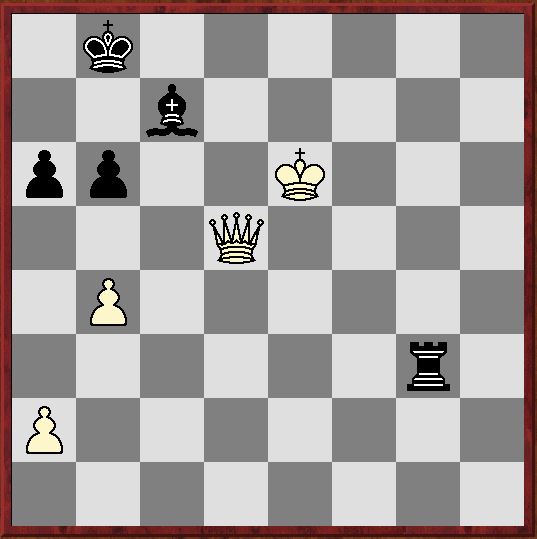
Garry and I played a few games tonight and the ending with Queen & three pawns versus Rook, Bishop & two pawns came up in a game. The Queen & pawns won easily enough. So we started looking at the ending withjust two pawns for the side with the Queen. We arrived at this position:


White to play

I thought I had a winning plan with 1 Qg8+ Ka7 2 Qc8. Was I correct that this was a winning line? If not, can White's play be improved?

I will give the answers in the following post.